
Base Preparation Hobart
Everything that matters about how long an asphalt or concrete surface lasts comes from what's underneath. A base that was compacted properly holds its shape for 25 years. One that was rushed or under-specified starts failing within three.
We supply base preparation as part of our own asphalt jobs, and as a stand-alone service for builders, concreters, and civil contractors who want the base done before they bring their crew in.
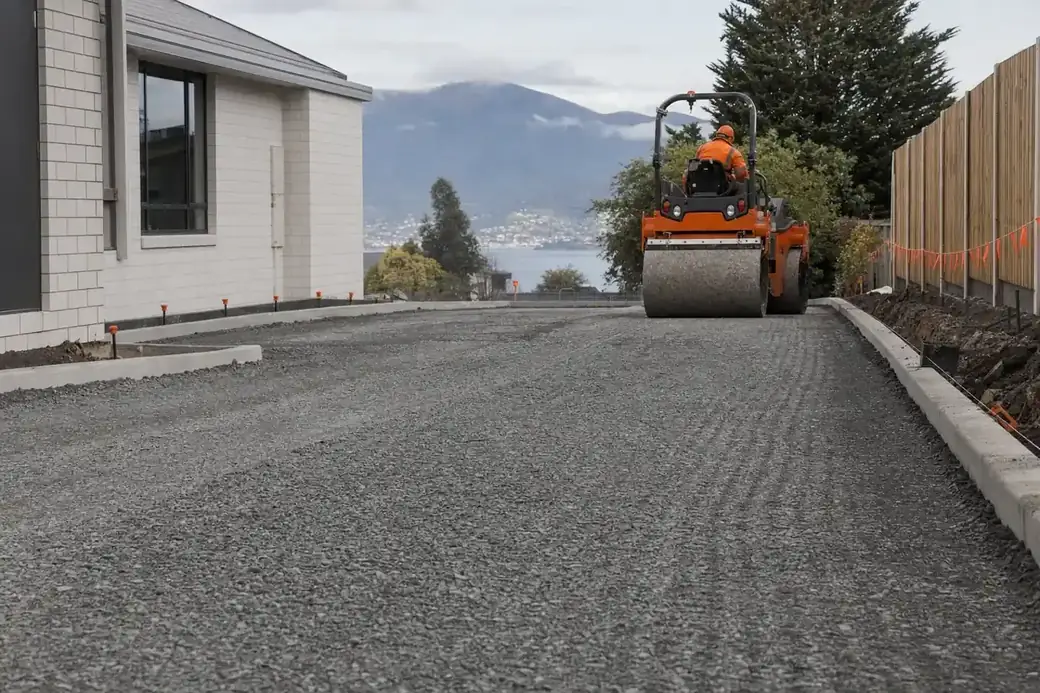
Material is quarry-sourced Tasmanian road-base, compacted in layers to 95%+ density, with drainage falls graded across the surface before the next trade arrives.
Why it matters
- Base preparation is the single biggest determinant of surface life for any paved area
- 95%+ compaction density stops the sub-base settling and pulling the surface down with it
- Correctly graded falls, typically 1:50 to 1:80, mean water runs off instead of sitting and working its way under the surface
- Local Tasmanian quarry material is correctly graded for the region's conditions
- Density test certificates available for builders and civil contractors who need documentation
THE PROCESS
How we do it
Site assessment
Check the existing ground conditions, identify any soft spots, fill areas or organic material that needs to come out before any base material goes in.
Strip and excavate
Remove topsoil, organic matter, and any material that won't compact to a stable subgrade. Disposed off-site or stockpiled per the client's preference.
Subgrade compaction
Compact the native ground or replacement subgrade as the platform for the road-base layer.
Road-base supply and spread
Quarry-sourced road-base spread at 100–150mm depth depending on the intended surface use and load.
Compact in layers
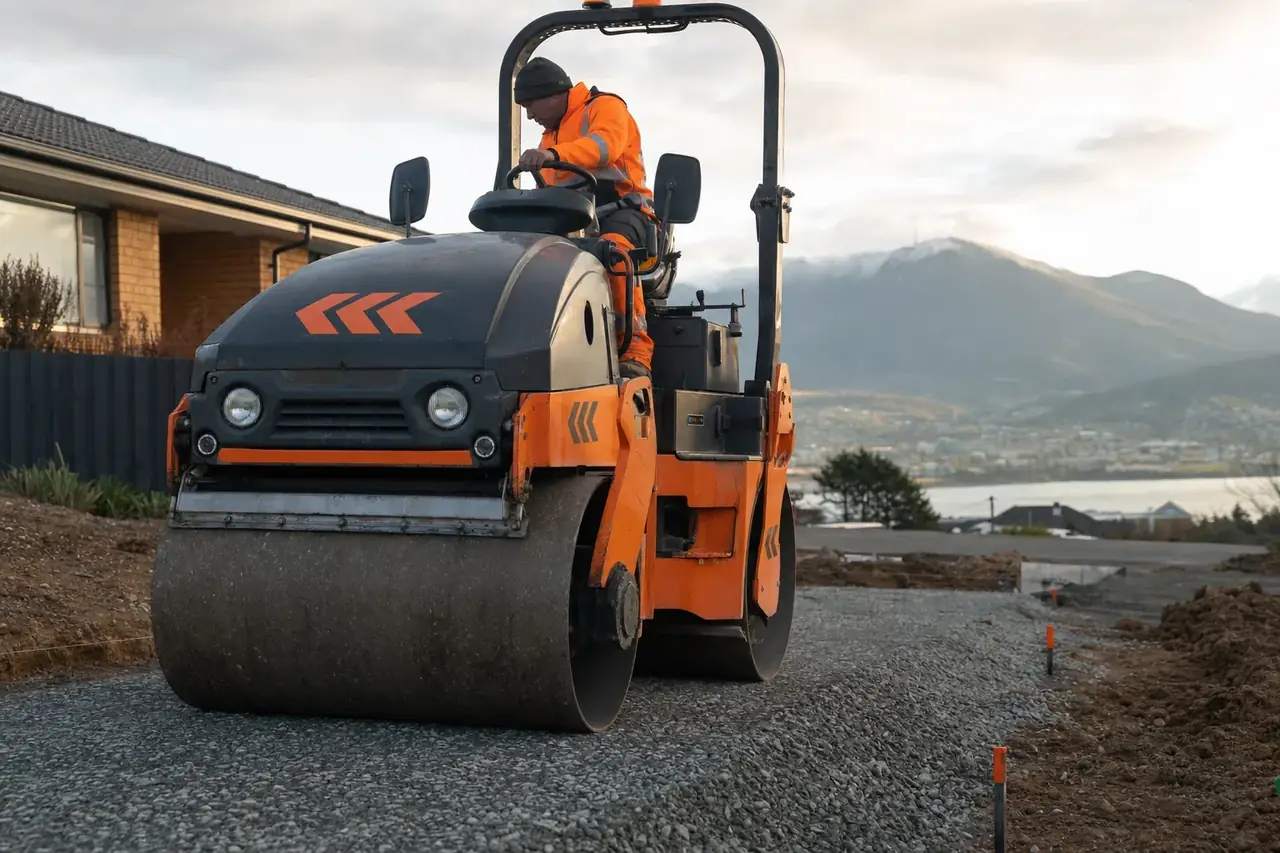
Vibratory roller compaction run in multiple passes, density tested on request.
Set falls and hand over
Final grade to confirm correct drainage falls. Site handed over ready for asphalt or concrete lay.
COMPARISON
How it stacks up
The sub-base material you choose affects cost, bearing capacity, and long-term stability. Three common options and when each is appropriate.
| Feature | Crushed road-base (FCR) | Recycled crushed concrete | Subgrade only (no imported base) |
|---|---|---|---|
| Cost per m³ | Standard, local Tassie quarries | Lower, recycled from demolition | Lowest, existing site material |
| Bearing capacity | Excellent | Very good | Variable, depends on soil type |
| Achievable compaction | 100% MMDD | 98% MMDD | Native compaction only |
| Best for | All driveways, carparks and roads | Cost-sensitive jobs, light to moderate traffic | Pedestrian paths only, not vehicle loads |
| Drainage | Free-draining when correctly graded | Free-draining when correctly graded | Depends on subgrade permeability |
| Tasmanian supply | Local quarries, readily available, short lead time | Recycled from local demolition projects | Existing site material, no transport cost |
| Council acceptance | All job types | Yes for residential and light commercial | Pedestrian and light use only |
| Hobart clay subgrade handling | Excellent, with geotextile on heavy clay sites | Good, with geotextile on heavy clay sites | Not suitable for clay subgrades under vehicle loads |
AFTERCARE
Reading the signals that tell you about your base
You don't maintain the base directly, but the surface above it tells you how the base is performing over time. These are the signs to watch.
Year 1 surface evenness
Any rutting or depressions visible in the asphalt inside the first year points to base compaction that didn't reach spec. A well-compacted base holds flat, no dips wider than a 10-cent piece.
Year 2–5 edge stability
Edges that slope away or crumble at the perimeter indicate either undersized base depth or poor edge containment. Correct base prep includes a 50mm wider footprint than the surface above, giving the edge something solid to sit against.
Water ponding after rain
Hobart gets consistent winter rainfall. Water pooling on the driveway or carpark after rain and not sheeting off within a few minutes means the drainage falls weren't set correctly at the base prep stage.
Tree root activity
Roots lifting the asphalt within 5–7 years indicate original base depth was too shallow. Correct base prep near mature trees includes deeper excavation and a root barrier at the base perimeter.
Utility lid settlement
Service lids that drop below the surrounding asphalt indicate the trench reinstatement wasn't compacted in layers. Proper base work over service trenches requires 150mm lifts and separate compaction between each.
Staining or bleeding at the surface
If the asphalt surface shows black or oily bleed-through in hot weather, the binder content may have been too high or the base wasn't absorbing load correctly. We can assess this at a site visit and advise whether a mill-and-correct is needed.
PRICING
What it costs in Hobart (2026)
- $Standard residential base prep for a driveway: $25–$45/m² depending on excavation depth
- $Commercial base prep for carpark: $30–$55/m² depending on access and required depth
- $Stand-alone base prep only (no surface lay): minimum $1,200 mobilisation
- $Surcharge for excavation over 200mm deep: add $20–$35/m²
- $Excavated material disposal: $40–$90 per cubic metre removed from site
- $Compaction density test certificate: $120–$200 per certificate
Site-specific factors change every quote. Get the price in writing before you commit to anything.
FAQ
Base Preparation, common questions
Can I organise my own base prep and just get you to lay the asphalt?+
Possible, but we'd inspect before laying and we won't go on a base we haven't approved. More often than not it's simpler and cheaper to let us manage both, we know exactly what spec we need to lay on.
What's the difference between road-base and crushed rock?+
Road-base is a blended and graded mix of crushed material plus fine particles that locks together when compacted. Single-size crushed rock doesn't compact properly and isn't suitable for driveways or roads. Always road-base under asphalt.
How deep does the road-base layer need to be?+
Residential passenger-vehicle driveway: 100mm minimum. Heavy-vehicle access: 150mm. Carpark: 150–200mm. Road pavement: 250–300mm. We'll specify the right depth at the quote.
Do you test compaction density?+
Yes. We compact to 95%+ Modified Maximum Dry Density for residential work, 98% for commercial. Density test certificates are available on request for builders and civil contractors who need documentation.
Can you do base prep for a concrete slab, not asphalt?+
Yes, same process. Concrete needs the same quality sub-base as asphalt, actually more consistent, since concrete is rigid and doesn't flex over soft spots the way asphalt does.
What soil types are common under Hobart driveways and do they affect the base spec?+
Hobart soils vary significantly by suburb. Sandy Bay and Battery Point often have clay-heavy soils that hold water and have low bearing capacity, these require deeper excavation and sometimes a geotextile fabric between the subgrade and road-base. Glenorchy and Moonah have a mix of fill and native soil from older subdivision activity. Bellerive and Howrah tend to have sandier coastal soils that drain well but can be loose without good compaction.
What is a geotextile fabric and when is it needed?+
A geotextile is a permeable textile laid between the subgrade and the road-base layer. It prevents fine clay particles from pumping up into the road-base under load, which is the mechanism that causes base loss and eventual surface failure in wet, soft-soil sites. On clay subgrades in Hobart's wetter locations, we include geotextile as standard.
Can base prep work be done in winter?+
Yes, with care. Compaction works best in dry conditions, a wet base compacts poorly and can spring back after the roller passes. We can work through Hobart winters but schedule base work for dry spells. If rain comes mid-job, we stop and cover the base rather than compact wet material.
What is a proof-roll and why does it matter?+
A proof-roll is a final pass over the compacted subgrade with a heavy machine, usually a loaded roller or the machine we've been using, to identify any remaining soft spots. If the surface 'pumps' or deflects under the weight, that area needs further compaction or replacement before base material goes on. Skipping the proof-roll is how jobs end up with depressions in the finished surface within the first year.
Do you supply and deliver the road-base or does the client source it?+
We supply and deliver quarry-sourced road-base as part of our base preparation service. Tasmanian quarry material is readily available from local suppliers and we manage the delivery schedule to keep the job moving. If a client wants to supply their own material, we'll inspect and approve it before spreading and compacting, we won't compact material that won't meet the required density.
READY TO START?
Free quote, in writing
We come out, take a look, and hand you a fixed written price within 48 hours. No obligation, no pressure, no bait-and-switch on the day.
Need base preparation?
Free site visit. Written quote within 48 hours.
(03) 6170 6004Quotes usually within 48 hours
READY TO START?
Get a free quote
We come out, take a look, and hand you a written price within 48 hours. No obligation, no pressure.