
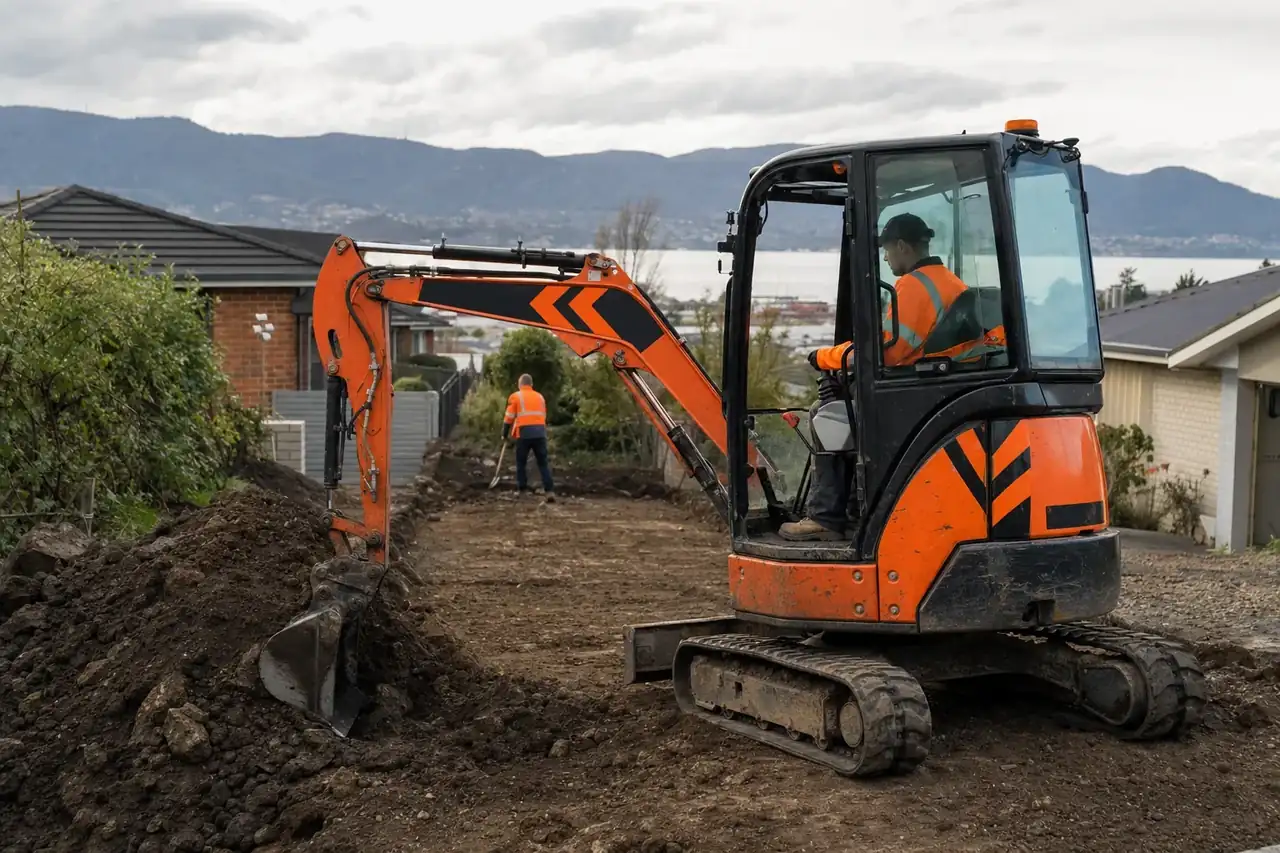
Driveway Excavation Hobart
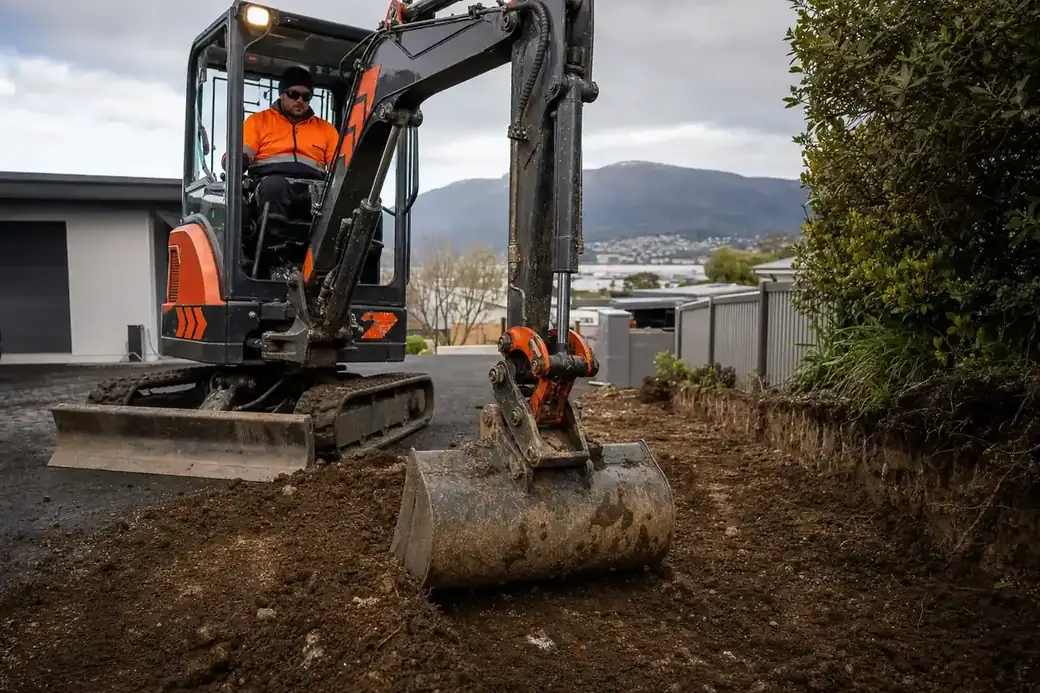
Every new driveway begins with excavation. Strip the organic material, establish the correct levels, clear out anything that won't compact, and prepare the ground so the base crew has a stable platform to work from.
We offer driveway excavation as a stand-alone service for builders and owner-builders managing their own timelines, or as the first phase of our complete driveway package.
Our kit is right-sized for Hobart's residential blocks, mini-excavator and skid-steer with low ground pressure, designed to work in tight suburban sites without tearing up the lawn on the way in.
Why it matters
- Correctly established levels at the excavation stage set up the drainage falls for the life of the driveway
- Removing organic material and topsoil prevents long-term settlement that shows up in the surface above
- Exposing the sub-grade early identifies soft spots before expensive asphalt or concrete is poured on top
- Underground service clearance done at this stage prevents costly damage later in the build
- Laser levels used on every job, not guesswork, not eye-balling, actual measured falls
THE PROCESS
How we do it
Driveway peg-out and DBYD
Mark out the full footprint of the driveway, run a Dial Before You Dig to locate and identify underground services before any cutting starts.
Topsoil strip
Remove the organic topsoil layer to firm ground. Useable topsoil stockpiled on site or removed per the client's preference.
Excavate to target depth
Dig to 150–250mm below finished surface level depending on the planned surface and base thickness.
Remove unstable material
Any soft, wet, or organic-rich sub-soil removed and replaced with quarry road-base before we leave.
Set levels and falls
Laser level used to establish the correct drainage falls across the dug area, typically 1:60 to 1:80 toward the road.
Subgrade proof roll and handover
Compact the exposed subgrade, proof-roll with the machine to identify remaining soft spots, hand over with levels pegged for the next trade.
COMPARISON
How it stacks up
Excavation method depends on site access, soil type, and what's overhead or underground. Three options and where each fits.
| Feature | Hand-dig | Skid-steer loader | Mini-excavator (1.5-3t) |
|---|---|---|---|
| Cost per m³ removed | Highest, labour intensive | Mid, efficient on open sites | Lowest per m³ on accessible sites |
| Speed | Slowest | Fast | Fastest |
| Gate access required | Any access, tools fit anywhere | Through 1.2m opening minimum | Through 1.5m opening minimum |
| Best for | Very tight access, near live services, confined excavation | Standard Hobart suburban driveway with reasonable access | Larger residential and commercial, open or moderate access |
| Garden disruption | Minimal, no tracks to manage | Some disruption around access path | Moderate if site is tight or access is through lawn |
| Spoil handling | Wheelbarrow to truck, slow but manageable | Direct load to truck | Direct load to truck, fastest |
| Effective depth | 1m practical limit before shoring needed | 1.5m comfortable | 2.5m+ achievable |
| Near-service work | Best for within 300mm of known services | Can work carefully to within 500mm | Requires hand-exposure within 300mm of services |
AFTERCARE
What we leave behind and why it matters
Excavation is the roughest phase of any driveway build. What the site looks like when we leave sets the quality benchmark for everything that follows.
Spoil removed
All excavated material taken from site by us. Clay and sub-soil to disposal, useable topsoil separated and retained if the owner wants it for garden beds or landscaping.
Sub-grade levelled and proof-rolled
The dig floor is left smooth, graded to correct falls, and proof-rolled to expose any remaining soft spots before we leave. Soft spots get dug out and replaced on the day, not left for the next trade to discover.
Service lines protected
Any service pipes or cables exposed during the dig are wrapped or physically barricaded so the base prep crew doesn't hit them on the next visit.
Level pegs and paint marks
We leave timber pegs and spray-paint marks showing the finished driveway footprint, the fall directions, and the target finished surface level. Any qualified contractor can use these without further instruction.
Site left tidy
Loose soil off the lawn, footpath cleared, no dirt tracked onto the road. Tasmania has rules about depositing material on public roads and we keep the site clean on every job.
Temporary protection in wet weather
If rain is forecast before the base crew arrives, we cover the exposed subgrade with polythene sheeting. An exposed clay subgrade saturated by a Hobart winter downpour needs to dry out before it will compact properly, a polythene cover costs nothing and saves a half-day of waiting at the next visit.
Handover notes for the next contractor
We leave a written note at the site (and email a copy to the client) recording the excavation depth achieved, the subgrade material type encountered, any services found and their location, and the drainage fall direction and gradient set. The next trade doesn't have to guess, it's all documented.
PRICING
What it costs in Hobart (2026)
- $Standard residential driveway excavation 60–100m²: $1,500–$3,500 depending on depth and access
- $Excavation only (without base prep): minimum $1,200 to cover mobilisation
- $Soil removal from site: $40–$90 per cubic metre
- $Tight-access surcharge where smaller equipment or hand-dig is required: $300–$800
- $DBYD and service location: included in standard quote
- $Level pegs and documented handover for third-party contractors: included
Site-specific factors change every quote. Get the price in writing before you commit to anything.
FAQ
Driveway Excavation, common questions
How deep does a driveway excavation go?+
Residential asphalt: 150–200mm total (100mm road-base plus 50mm asphalt). Residential concrete: 200–250mm (150mm road-base plus 100mm concrete). Heavier vehicle access needs more depth again and we specify that at the quote.
What happens to the dirt that comes out?+
Topsoil suitable for garden use is kept on site if the owner wants it. Sub-soil and unstable material is loaded and disposed of off-site. We quote disposal cost separately so you know exactly what's included and what isn't.
Can I have the excavation done now and the asphalt done in a few months?+
Yes, this is common for builders managing staged works. We leave the site pegged with level markers so any contractor can read the falls. Best to get asphalt down within 6–8 weeks of excavation to protect the prepared subgrade from weather damage.
Can you excavate without damaging the surrounding garden?+
We use ground protection mats across lawn and garden beds where the machine needs to track through. Access is discussed at the site visit and we choose the smallest equipment that gets the job done.
Do you do excavation for retaining walls?+
We handle the excavation side. For the wall construction itself we usually coordinate with a block or stone specialist. We dig, they build the wall, we come back for the driveway surface.
What happens if underground services are found during the dig?+
We stop immediately and assess the find. The Dial Before You Dig search identifies known registered services, but older or private services not on the DBYD register can still be present. We hand-expose around any unexpected find, identify what it is, and consult with the service owner before continuing. We do not dig through a live service.
Hobart has a lot of hilly ground. How do you handle steep driveway sites?+
Steep driveway sites in suburbs like Battery Point, Sandy Bay and North Hobart require a cut-and-fill approach, cutting into the uphill side and building up on the downhill side to create a consistent gradient. We assess the cut depth and fill volumes at the site visit, include any retaining requirement in the scope, and specify the correct compaction approach for fill material to prevent settlement over time.
Can you coordinate with my builder if this is part of a new house construction?+
Yes. We work alongside building contractors frequently and are used to coordinating site access, timing, and handover between trades. Give us the builder's contact and we'll deal directly with them on scheduling so you don't have to manage it.
How do you handle rock if it's found during excavation?+
Hard rock under a Hobart residential site is not common but does occur, particularly in hillside suburbs where the sandstone or dolerite is closer to the surface. If rock is encountered during excavation we stop, assess the extent, and requote the additional rock-breaking or rock-saw cost. We don't carry rock-breaking equipment on our standard kit, it's hired in when needed. Rock significantly changes the cost of an excavation and we want that to be a transparent conversation, not a surprise on the final bill.
What if the site is on a slope and water naturally drains through it?+
Sloped sites in greater Hobart often have natural water table movement that shows up as wet subgrade during excavation, particularly after a wet winter. We assess the ground moisture at the site inspection and, where sub-surface drainage is clearly an issue, can include a sub-soil drain in the scope, a slotted pipe in gravel running to a discharge point, to keep the base dry over the long term. Wet sub-grade that isn't addressed at excavation stage shows up as base failure within 3–5 years.
READY TO START?
Free quote, in writing
We come out, take a look, and hand you a fixed written price within 48 hours. No obligation, no pressure, no bait-and-switch on the day.
Need driveway excavation?
Free site visit. Written quote within 48 hours.
(03) 6170 6004Quotes usually within 48 hours
READY TO START?
Get a free quote
We come out, take a look, and hand you a written price within 48 hours. No obligation, no pressure.