
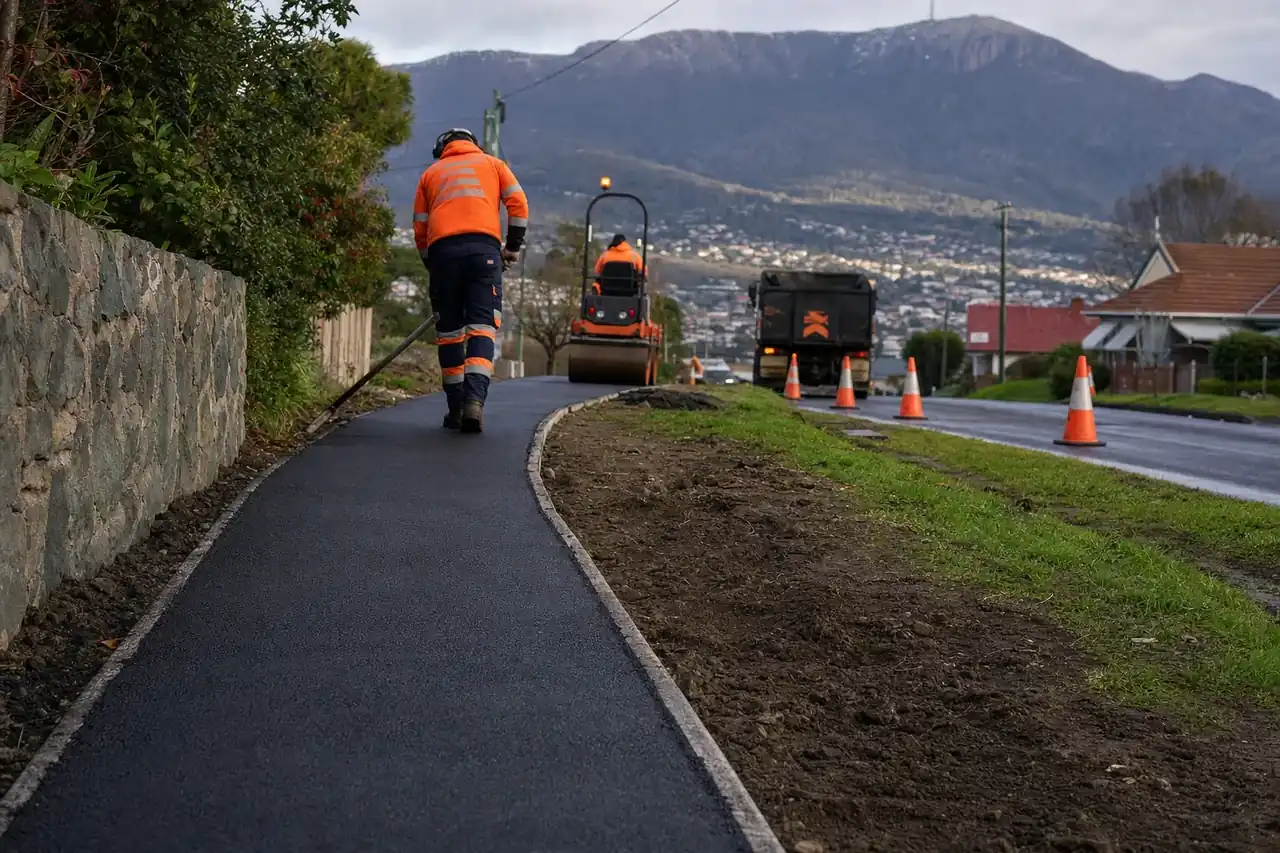
Asphalt Footpaths Hobart
Footpaths carry the highest pedestrian density of any paved surface and need to be flat, grippy, and free of lips or drops. A trip hazard on a public footpath is a council compliance issue and a liability problem.
We build and reinstate footpaths for Hobart area councils, residential side-passage paths, school entry paths, community walkways and small commercial pedestrian zones. Asphalt or concrete depending on what the application calls for.
Footpath mix design is different to driveway mix. Lower binder content, finer aggregate, finished to a pedestrian slip rating. Getting the spec right matters more on a surface that people walk on than on one they drive on.
Why it matters
- Slip-rated surface designed for wet-weather foot traffic common across Hobart's winters
- Flush transitions with existing surfaces eliminate the trip hazards that generate claims
- DDA-compliant gradient and transition zones where required
- Quick turnaround minimises footpath closure duration for council and public works
- Both asphalt and concrete available, quoted together so you can choose on cost and longevity
THE PROCESS
How we do it
Measure and scope
On-site measure, check path gradient, width requirements, drainage, and confirm the specification with the client or council.
Sub-base preparation
Strip and compact road-base sub-base, set falls at 1:50 cross-fall as per pedestrian path standard.
Edge formwork
Timber forms where the path edge abuts soft ground, grass verge, or garden bed.
Lay and screed
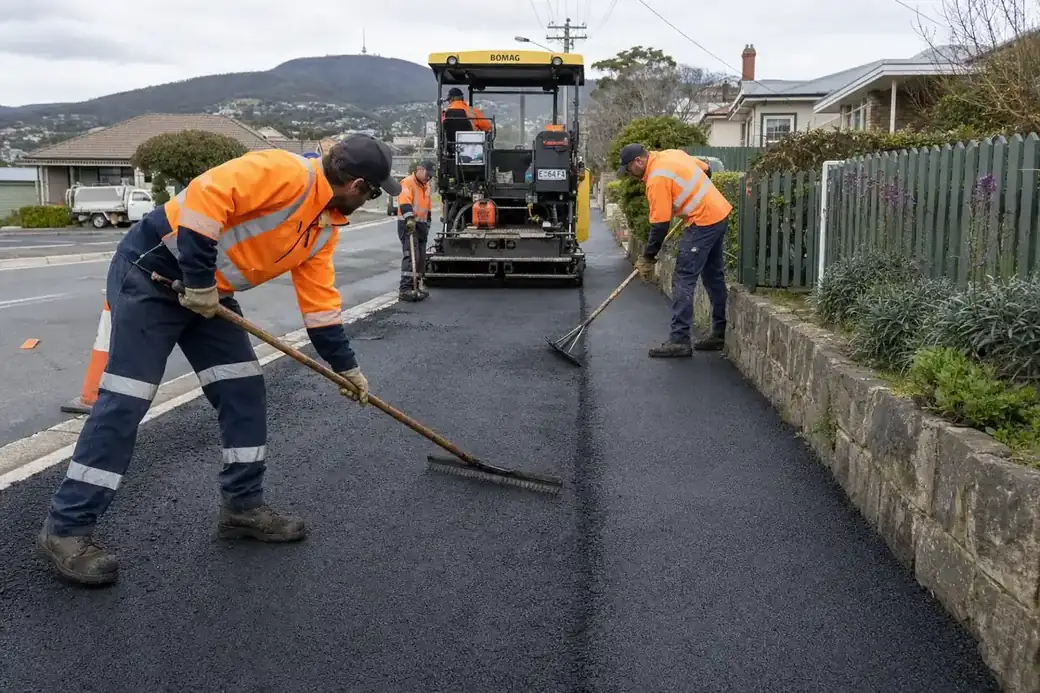
Hand screed or small tracked paver, depending on path length and access. Asphalt delivered and worked while hot.
Compact and finish
Pedestrian-spec asphalt compacted to a safe, even surface profile. Broom-finished for wet-weather grip.
Open for pedestrians
Cured and safely walkable within hours. No long wait before re-opening.
COMPARISON
How it stacks up
Pathway surfaces come in three main options. The best choice depends on access needs, traffic type, and the surrounding streetscape.
| Feature | Asphalt footpath | Concrete footpath | Block paving |
|---|---|---|---|
| Cost per m² | Lowest, $55–$85/m² | Mid, $90–$140/m² | Highest, $120–$200/m² |
| Lifespan | 20-25 years | 40+ years | 30+ years with maintenance |
| Smoothness for wheelchair and pram | Excellent when new, minor ageing over time | Excellent consistently, rigid surface | Vibration over mortar joints |
| Trip hazard risk | Low, flexible, slight movement | Low, but control joints can lift | Higher if individual blocks shift |
| Repair if damaged | Simple, asphalt section blends in | Difficult, panels show repair | Straightforward, relay individual blocks |
| Tree-root tolerance | Better, asphalt has slight flex | Cracks under sustained root pressure | Lifts at root site, individual blocks |
| DDA compliance achievable | Yes, when correctly graded and finished | Yes, when correctly graded and finished | Check with council, jointing can fail R10 |
| Hobart wet weather grip | R10-R11 broom finish, good for wet winters | R10-R12 broom finish, generally excellent | Depends on block surface texture and condition |
AFTERCARE
Looking after the path
Footpaths are low-maintenance surfaces once they're down. Tree roots and edge drainage are the two things that shorten their life most often in Hobart's wet climate.
Tree roots nearby
Any established tree within 3 metres of the path will eventually try to lift it. Prune surface roots before they cause uplift, or budget for a section re-pour once lifting starts. Catching it early is far cheaper.
Monitor edge drainage
Path edges that drain onto an unsealed garden bed or verge can undercut themselves after heavy rain. Check for any soft spots after big rainfall events and top up with crushed rock if the edge is starting to hollow.
Crack sealing
Hairline cracking from year 8 onward is normal ageing on asphalt. Seal it before cracks widen and let water in. Around $3–$5 per linear metre.
Autumn sweep
Clear fallen leaves in autumn before they decompose against the asphalt surface. Organic matter holds moisture and accelerates surface degradation over time.
Check transitions after frost
Hobart winters bring occasional ground frosts, particularly in Glenorchy, Moonah and New Town where overnight temperatures drop lower than the inner city. Frost heave can lift the edge of an asphalt path by a few millimetres. Walk the transitions after the first cold snap each year and seal any lip that's opened up.
Year 10 re-seal or section overlay
A full re-seal at year 10 gives a residential footpath another 15 years without complete replacement. For council or commercial paths with high foot traffic, a section-by-section overlay programme is the most cost-effective approach, patch the sections showing wear first and re-seal the rest.
PRICING
What it costs in Hobart (2026)
- $Standard 1.2m wide asphalt footpath: $55–$85/m² supplied and laid
- $Wider 1.5m+ council-standard path: $50–$75/m²
- $Concrete footpath: $90–$140/m² supplied and laid
- $Short residential side-passage paths under 10m²: typically $1,200–$2,200 minimum job
- $Council reinstatement work: priced per linear metre, varies by council specification
- $DDA-compliant path with tactile ground surface indicators: add $50–$80/m² for the TGSI section
Site-specific factors change every quote. Get the price in writing before you commit to anything.
FAQ
Footpaths & Pathways, common questions
Can you lay a concrete footpath instead of asphalt?+
Yes, both are available. Concrete lasts longer, 40+ years versus 25 for asphalt, but costs more up front. Asphalt is faster to lay and easier to repair. We quote both options at the same site visit.
What slip rating do you finish footpaths to?+
R10–R11 wet for residential footpaths, R11 for council-standard and commercial pedestrian areas. We adjust the finishing technique (broom direction, surface texture) to reach the required rating.
Can you do a DDA-accessible footpath?+
Yes. We work to AS 1428.1 for gradient and transition zones where disability access compliance is required.
Do you repair sections of footpath, not just build new?+
Both. Small section repairs typically run $300–$700. Full panel replacement (concrete) or section overlay (asphalt) scales with area and access.
Does residential side-path work need council approval?+
Not usually. A side-passage path entirely within your property boundary doesn't require council sign-off. Anything on the road reserve does.
How do you handle paths on sloped Hobart terrain?+
Hobart's topography means many footpaths run across considerable gradients, particularly in Sandy Bay, Battery Point and North Hobart. We set the longitudinal gradient to a maximum of 1:8 for general pedestrian paths and 1:14 for DDA-accessible paths, with in-line drainage on any extended run steeper than 1:20. Every sloped path quote includes a gradient check.
What's the minimum width for a shared pedestrian and bike path?+
Shared paths require a minimum of 2.5m for low-traffic routes and 3m where higher cycle and pedestrian flows are expected. The relevant standard is Austroads Guide to Road Design. We've built shared-use paths for local council and community organisations across the Hobart area, confirm the classification at the brief stage and we'll spec accordingly.
Tree roots nearby are lifting our existing path. What are our options?+
Three options: root-prune at the surface and relay the affected section; install a root barrier at the base of the new section to redirect future growth; or, on private property, remove the tree as part of a full path redesign. We don't make the tree-removal call, that involves council permits in most cases, but we can advise on which path option suits the site.
Can you do school entry path works during the school holidays?+
Yes, and holiday scheduling is the norm for school path work. We plan around the Tasmanian school holiday calendar for any school or early childhood centre job. January is typically the most efficient window for Hobart area schools, longest dry spell and the site is fully vacant.
How deep is the base for a pedestrian footpath versus a driveway?+
Pedestrian footpath: 75–100mm of compacted road-base under 30–40mm of asphalt. This is lighter than a driveway base because foot traffic imposes far lower load than vehicles. Shared pedestrian-cycle paths: 100–125mm base to handle the occasional delivery vehicle. If a path is likely to be driven on even rarely, loading dock approach, maintenance access, we spec it to driveway standard from the start.
READY TO START?
Free quote, in writing
We come out, take a look, and hand you a fixed written price within 48 hours. No obligation, no pressure, no bait-and-switch on the day.
Need footpaths & pathways?
Free site visit. Written quote within 48 hours.
(03) 6170 6004Quotes usually within 48 hours
READY TO START?
Get a free quote
We come out, take a look, and hand you a written price within 48 hours. No obligation, no pressure.