Asphalt or concrete, it's the question we field on practically every residential driveway quote in greater Hobart. Both materials hold up in southern Tasmania. Both can go decades without trouble on a good base. Both can fail inside five years on a bad one.
The real answer depends on what matters to you: upfront cost, total lifespan, how repairs look, and how the driveway sits against your house. This is a straight comparison from a crew that lays both, with no stake in which one you pick.
Cost per square metre installed
Asphalt is cheaper by a meaningful margin. For a standard residential driveway in greater Hobart, asphalt typically runs in the $50-80 per square metre range, supplied and laid. Concrete sits at $90-150 depending on finish, standard broom, exposed aggregate, or stencilled all land at different points.
On a 50m² driveway that gap is $1,500-3,500 in your pocket by going asphalt. Money that's better spent on solid base prep, which matters more to long-term durability than the surface material above it.
| Material | Typical installed cost/m² | Access ready | First repair visible? |
|---|---|---|---|
| Asphalt (hot mix) | $50-80 | 24-48 hours | No, blends after weathering |
| Concrete (broom finish) | $90-120 | 7 days | Yes, colour mismatch permanent |
| Concrete (exposed aggregate) | $115-150 | 7 days | Yes, texture impossible to match |
| Concrete (stencilled/coloured) | $130-170 | 7 days | Highly visible, colour fades unevenly |
Indicative installed costs for greater Hobart residential driveways, 2026.
Lifespan in southern Tasmanian conditions
Concrete wins on raw years in service. A properly laid concrete driveway in Hobart typically runs 30-40 years before it needs serious work. Asphalt sits at 20-25 years, extended toward 30 by a seal coat applied at year 7-10.
That said, the freeze-thaw cycles that hit elevated Hobart suburbs, think South Hobart slopes, West Hobart, and properties under kunanyi/Mt Wellington, stress concrete's expansion joints hard. Concrete cracks at those joints. Asphalt flexes through the cycle without the same consequences.
How the Hobart climate shapes the comparison
Southern Tasmania averages 85-100 frost days per year at higher elevations around the greater Hobart area. The Derwent Valley and properties above 200m can see sub-zero temperatures on clear nights most weeks through winter.
Every frost cycle is a micro-stress event on expansion joints in concrete. Asphalt's bitumen binder stays marginally flexible even in southern Tasmanian winters, which is why asphalt roads in cold climates consistently outperform concrete roads in frost-tolerance.
Lifespan compared side-by-side
| Material | Typical lifespan | Lifespan with maintenance | Key lifespan risk |
|---|---|---|---|
| Asphalt | 20-25 years | Up to 30 years with seal coat at year 7-10 | Sub-base failure, edge loss without restraint |
| Concrete (broom) | 30-40 years | 35-45 years with joint re-caulking | Expansion joint cracking, reactive subgrade movement |
| Concrete (exposed agg) | 25-35 years | Similar to broom with cleaning | Stone pop-out, surface staining, algae on shaded Hobart blocks |
If your driveway faces south or sits in shade most of the day
Shaded driveways in Hobart lose heat faster and stay wet longer after rain. Asphalt's black surface absorbs warmth on sunny days and dries out faster. Concrete holds surface moisture longer and can be slippery in the cold months. For south-facing driveways specifically, the asphalt case gets stronger.
Repair when something goes wrong
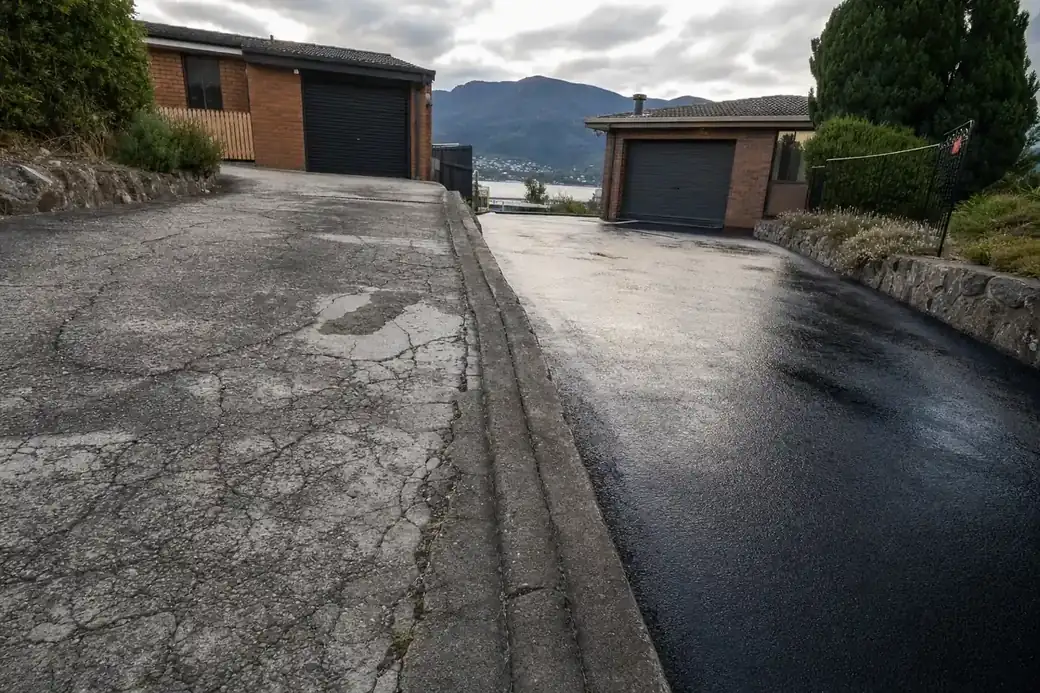
This is where asphalt pulls well ahead in day-to-day ownership. A pothole or failed section in asphalt gets squared off, cleaned, and filled with hot mix. After six months of weathering it blends into the surrounding surface and is effectively invisible.
A failed concrete section means sawcutting the slab out, removing it, waiting for a re-pour, and then living with a colour mismatch that never fully disappears. There's no patch-and-forget with concrete.
The crack repair comparison
- Asphalt crack (under 3mm): clean, fill with liquid crack filler, seal coat the surface, under $300 for a standard driveway
- Asphalt crack (over 3mm, base intact): patch compound or infrared repair, $200-600 depending on area
- Concrete crack: epoxy injection or sawcut and re-pour, $500-2,000 and always visible
- Concrete slab replacement: full panel removal and re-pour, $1,500-3,500 per panel plus matching colour surcharge
Pour window in cold weather
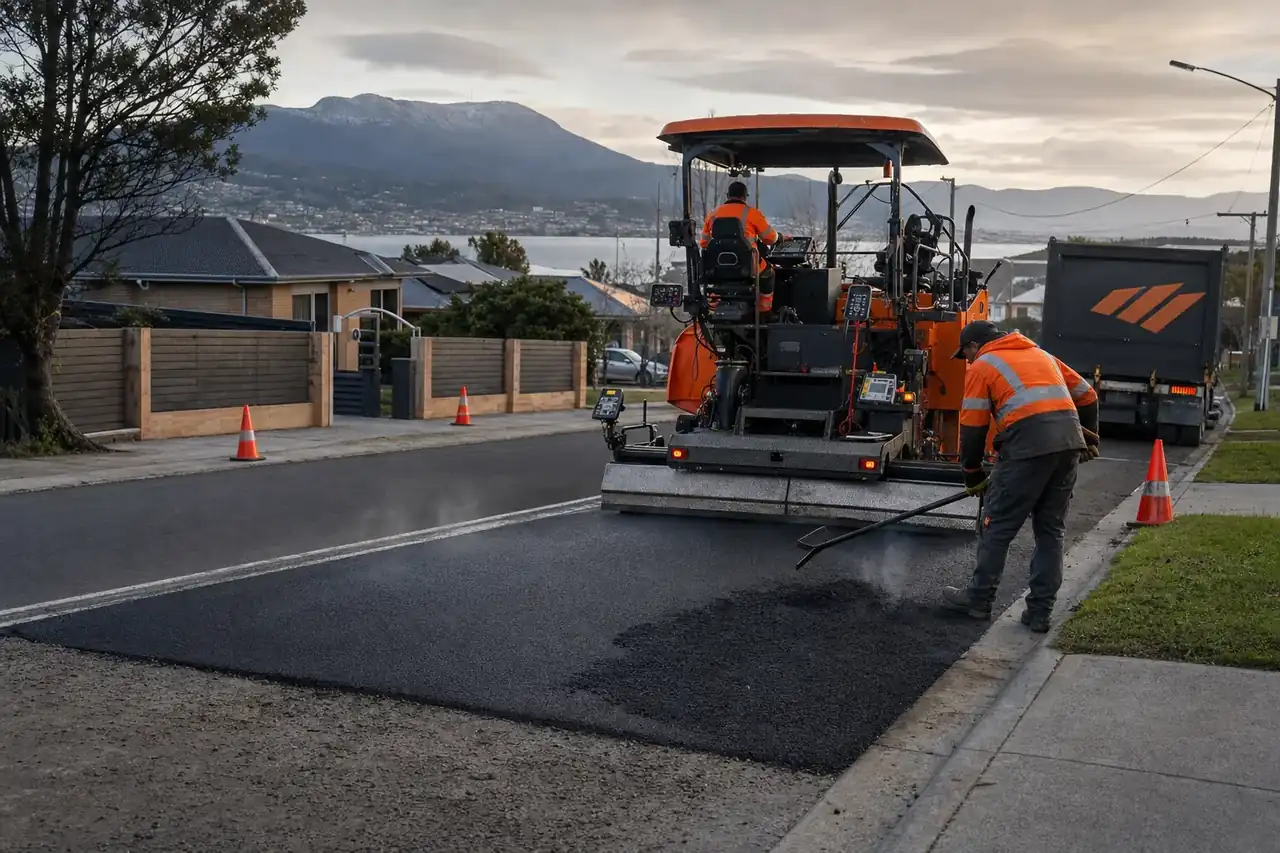
Asphalt has the wider window. We can lay hot mix in Hobart year-round provided the ground temperature is above 5°C and the conditions are dry. Concrete needs warmer, more stable conditions, above 10°C with no frost risk overnight.
In practical terms, asphalt can be scheduled most weeks through the southern winter. Concrete jobs in Hobart often shift from June-August into spring, which means waiting if your project has a fixed timeline.
Seasonal scheduling in Hobart
| Season | Asphalt | Concrete | Notes |
|---|---|---|---|
| Oct-Apr (spring/summer/autumn) | Any time, dry conditions | Any time | Peak season, longer lead times |
| May-Jun (early winter) | Most weeks, dry days | Marginal, check overnight forecast | Lead times start to shorten |
| Jul-Aug (deep winter) | Suitable dry days, ground temp >5°C | Not recommended | Shortest lead times of the year |
| Sep (early spring) | Any dry day | Most dry days | Demand rises fast, book early |
Appearance over time
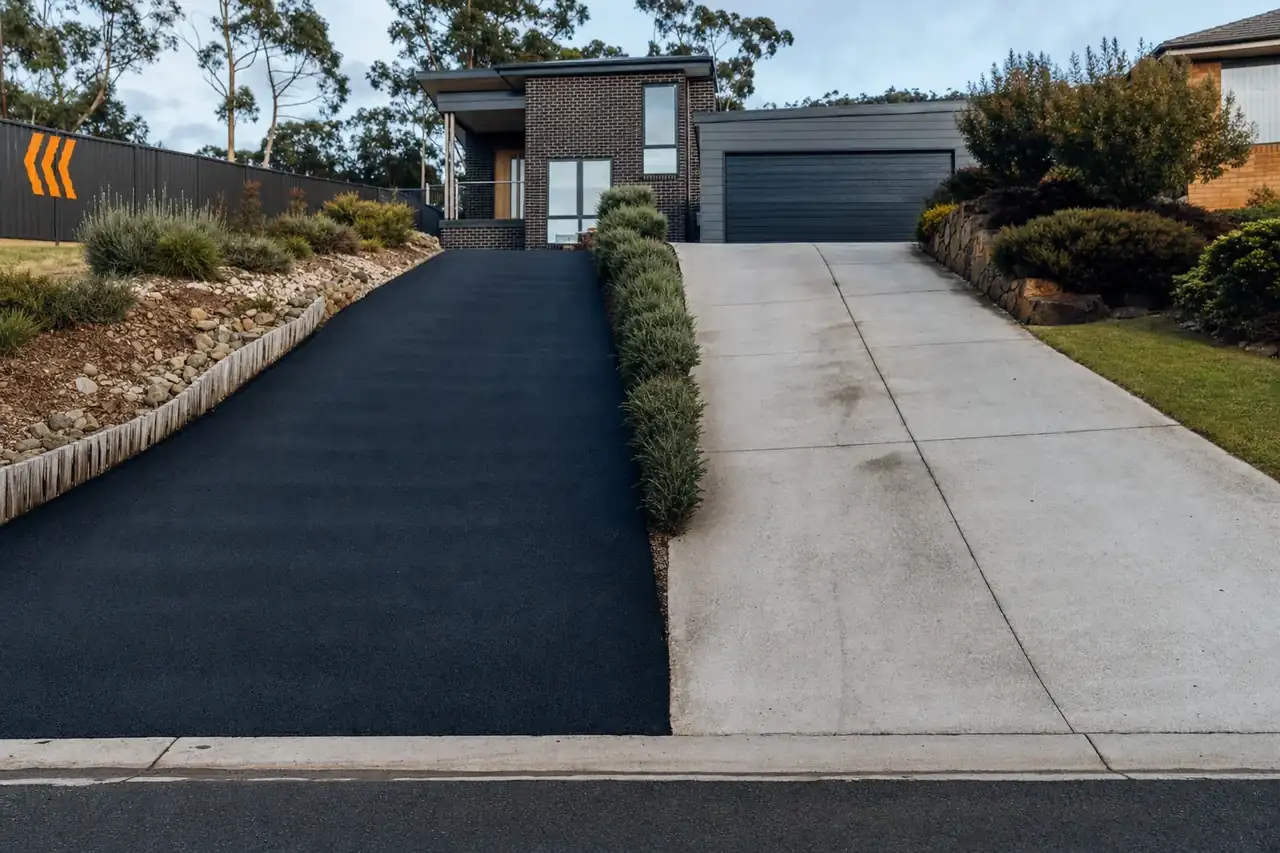
Asphalt goes on deep black and fades to dark charcoal over the years as the surface oxidises. Concrete starts stark white-grey, picks up oil stains, tyre marks, and algae over time, and can be finished with exposed aggregate or stencilling for visual texture.
Newer Hobart homes, weatherboard or brick veneer from the last couple of decades, typically sit better visually against asphalt's clean, dark face. Heritage properties in Battery Point or North Hobart sometimes suit concrete or decorative finishes.
The real question isn't which material is better in general. It's which one is right for your block, your budget, and what you'll want to do when it eventually needs attention.
Environmental and maintenance considerations
Asphalt is fully recyclable at end of life. Old asphalt gets milled, crushed and reprocessed into recycled asphalt product (RAP), which is standard base material on civil projects across Tasmania. Concrete demolition creates harder-to-reuse rubble, typically going to fill or aggregate grade.
Maintenance commitment differs too. Asphalt requires a seal coat every 5-7 years, which is a half-day job and minor cost. Concrete needs expansion joint re-caulking every 5-10 years to stop water penetration, and any cracked joints must be attended to promptly or the sub-base degrades.
Ongoing maintenance cost comparison
| Maintenance item | Asphalt | Concrete |
|---|---|---|
| Routine surface treatment | Seal coat every 5-7 yrs, $300-600 for 50m² | Joint re-caulking every 7-10 yrs, $150-400 |
| Crack repair | $100-600 typically, invisible after weathering | $500-2,000+ and always visible |
| Pothole or failed section | $200-800, patch blends in | $800-3,500 for slab replacement |
| Full resurface | Overlay at $30-45/m² when surface fails | Strip-out and re-pour only option |
Kerb appeal and property value
Driveways contribute to kerb appeal, which matters at sale time. In greater Hobart's current property market, a tired or failed driveway is a common negotiating point for buyers, while a freshly laid driveway with tidy edges and good falls is noted positively in property reports.
Asphalt laid to a high standard has a clean, sharp appearance that photographs well and reads well from the street. Concrete can look more formal, which suits some architectural styles, particularly rendered or masonry homes common in inner Sandy Bay or Battery Point.
Resale: what property buyers care about
- Is the driveway functional and safe? (Potholes and crumbling edges are negotiating points)
- Does it drain correctly? (Pooling water on the driveway is flagged in building inspections)
- Is the crossover council-approved? (Unapproved crossovers are flagged during conveyancing)
- How old is it, and what's the remaining life? (A sealed asphalt driveway looks recently maintained even if it's years old)
A seal coat before listing adds value
Reselling a Hobart property? A $400-600 seal coat on an existing asphalt driveway adds years to its apparent age and photographs black and fresh rather than grey and tired. It's one of the cheapest cosmetic updates with visible return.
Noise, glare and heat: the sensory comparison
Asphalt and concrete sound different under vehicle tyres. Asphalt's aggregate texture produces slightly less tyre noise at low speeds, the rubber makes softer contact with the flexible surface. This is a minor difference on a residential driveway but noticeable on shared access roads.
Concrete's pale surface reflects significantly more light than dark asphalt. On west or north-facing driveways that receive afternoon sun, concrete can produce glare that reflects into windows or onto the footpath. In summer this can contribute to surface heat around the home's entry. Asphalt absorbs heat rather than reflecting it, useful in the cooler months but can radiate warmth into the evening in summer.
Heat island effect in Hobart context
The urban heat island effect, where dark impermeable surfaces absorb solar radiation and raise local temperatures, is a concern in dense urban areas. In greater Hobart's climate, with its cooler baseline, this effect is less pronounced than in Sydney or Brisbane. The practical difference between an asphalt and concrete driveway on the temperature around a Hobart property is minimal compared to factors like tree coverage and building orientation.
Accessibility: gradient, surface texture and wheelchair compliance
Both asphalt and concrete can be built to meet accessibility gradient requirements (maximum 1:14 for residential access, 1:20 for public access). The texture difference matters for wheelchair and mobility aid users: dense-graded asphalt has a smooth surface that rolls easily. Exposed aggregate concrete has a rough texture that can increase rolling resistance.
For residential properties where accessibility is a consideration, a smooth AC10 asphalt finish is often the better choice. For any driveway or path that connects to a public footpath and will be used as a pedestrian route, check with the relevant Hobart council on compliance requirements, both materials can meet them with the right spec.
The Hobart climate verdict: asphalt-specific advantages
Southern Tasmania's climate creates a specific set of conditions where asphalt consistently holds its own against concrete. The factors that favour asphalt in Hobart specifically:
- Freeze-thaw: Hobart's frost season stresses concrete expansion joints; asphalt flexes without the same failure mode
- Year-round laying: asphalt can be scheduled through winter; concrete is effectively a spring/autumn material in Hobart
- Wet seasons: asphalt repairs after wet-winter damage are fast and invisible; concrete repairs are visible indefinitely
- Hillside properties: asphalt can be regraded and overlaid as ground movement occurs; concrete slabs crack and stay cracked
- Heritage areas: asphalt overlays are quicker to permit than concrete works in heritage overlay zones
Which one to go with
If the priorities are lower upfront cost, fast turnaround, and invisible repairs: asphalt. If the priority is maximum years in service and budget isn't the constraint: concrete. For the majority of Hobart residential driveways under 100m², we'd steer you toward asphalt on total lifecycle cost.
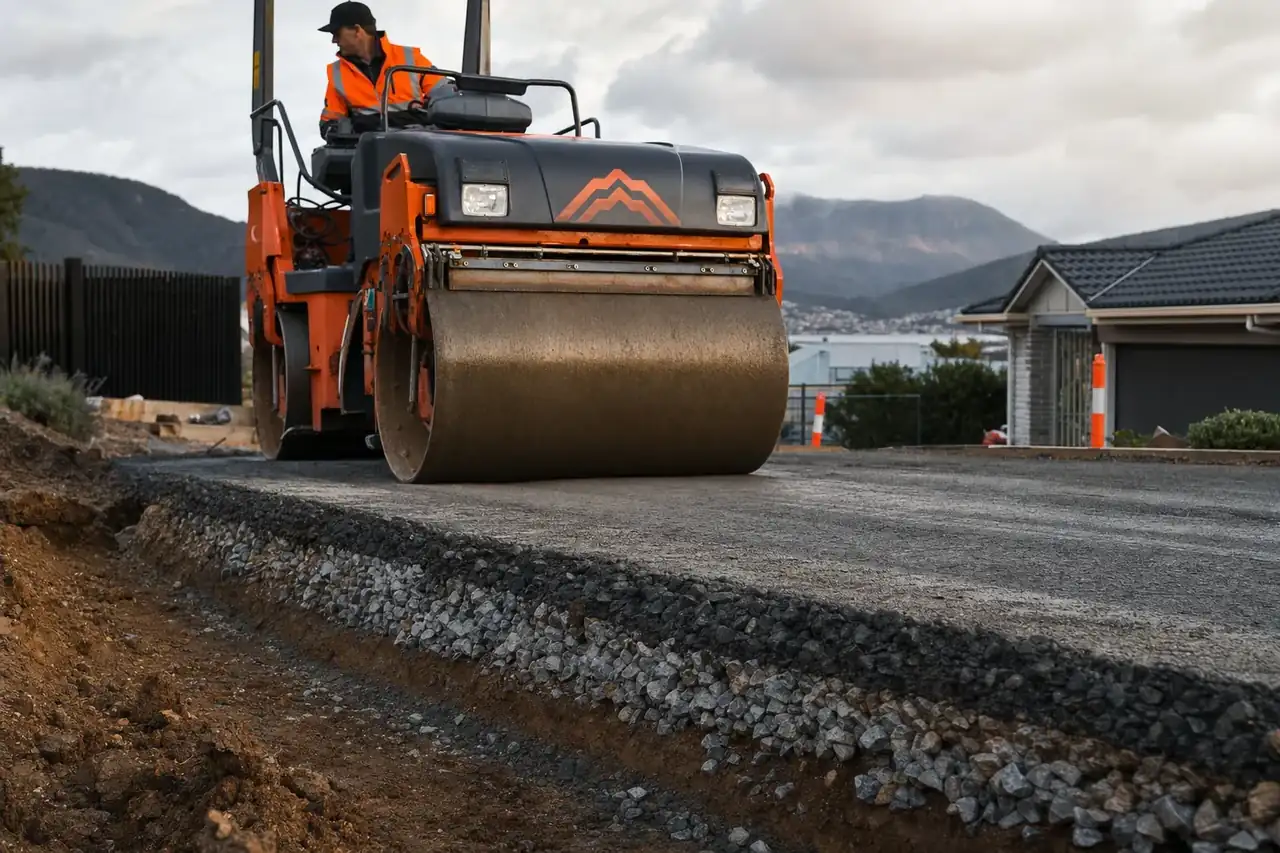
Both materials need the same thing underneath: a properly compacted, correctly graded sub-base. The surface is the last 40mm of a 200mm engineered system. Get the foundation right and either material will serve the property well.