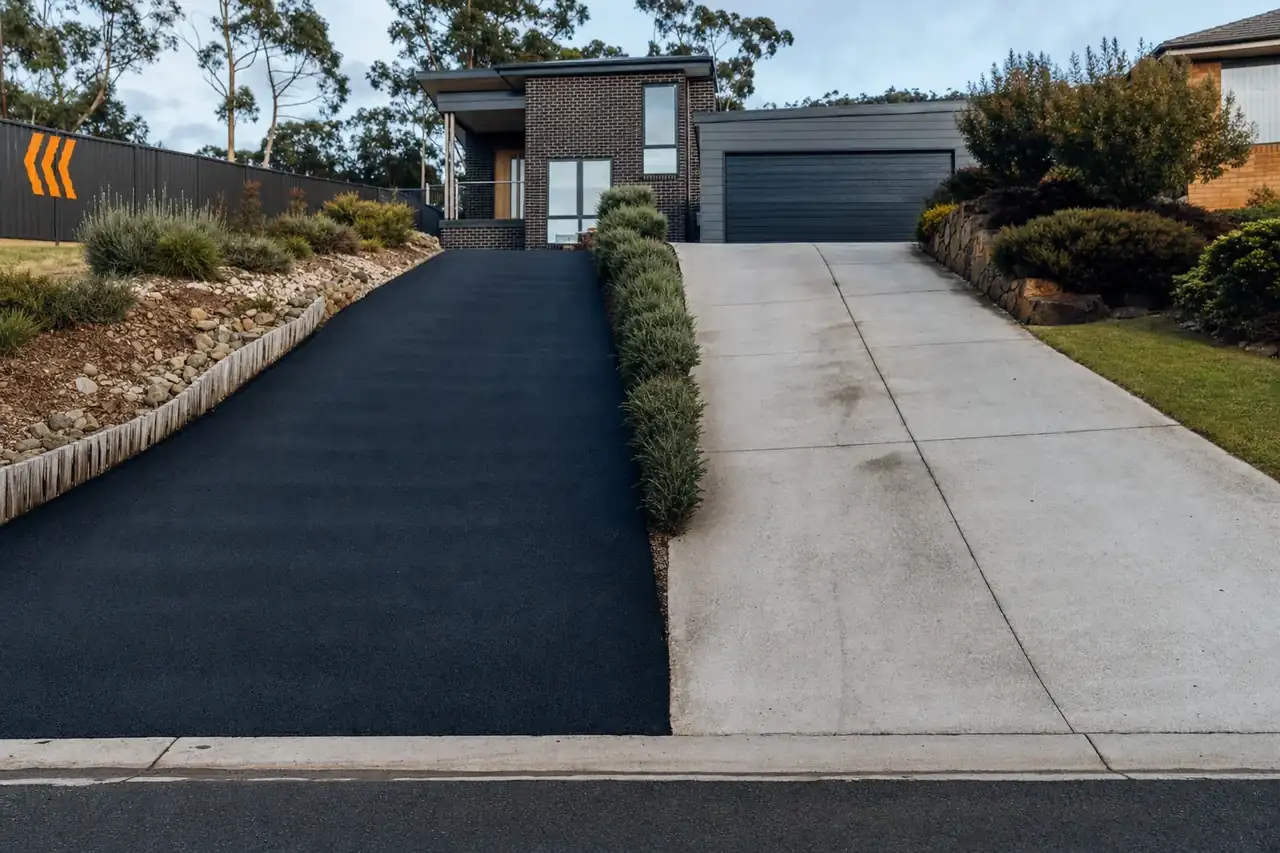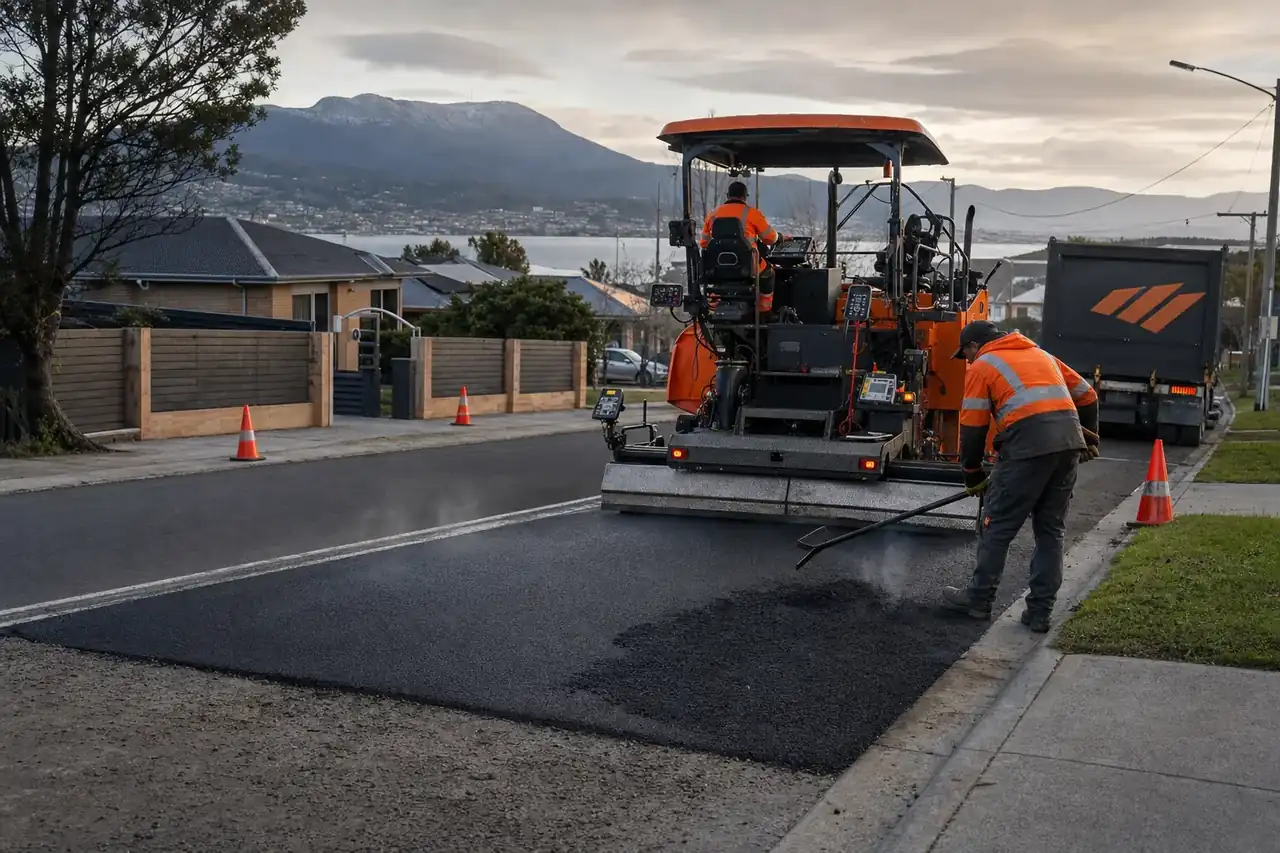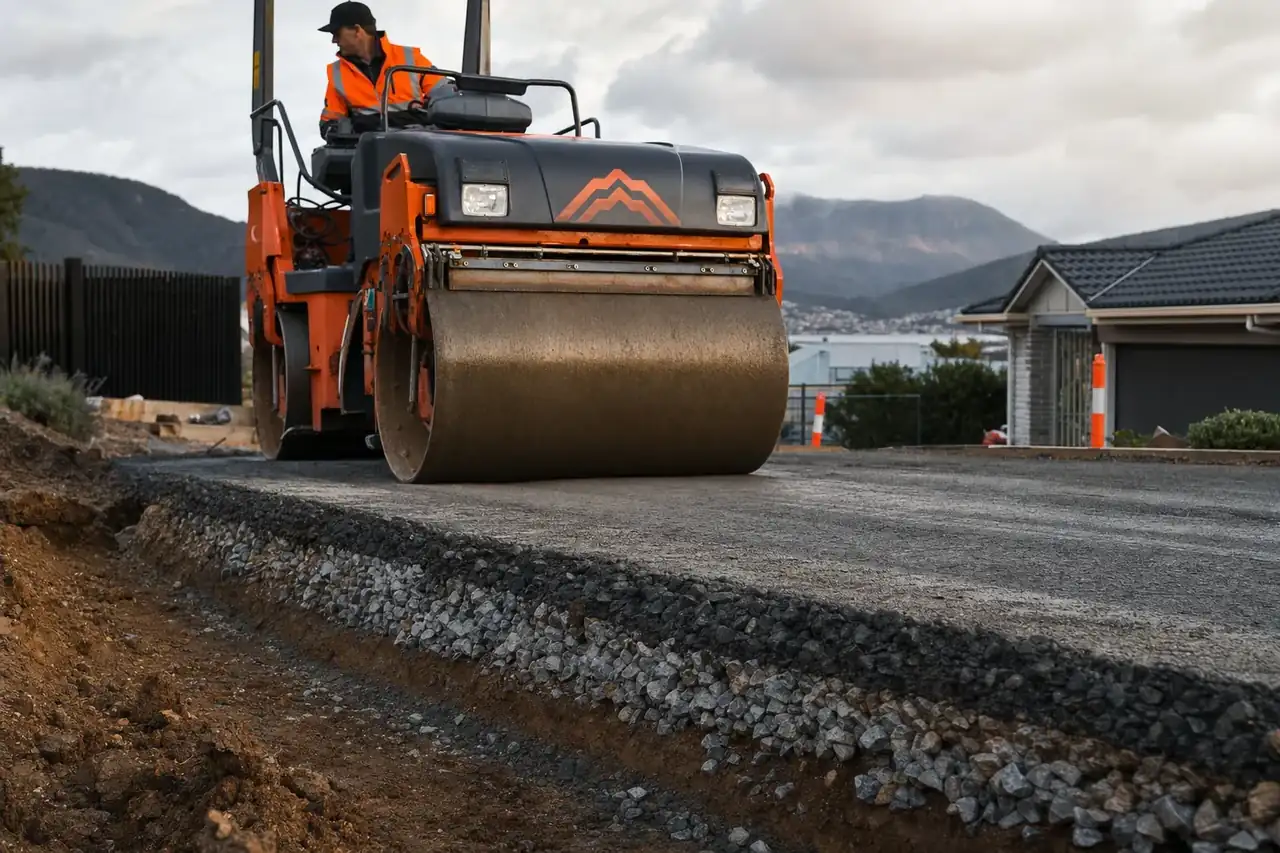
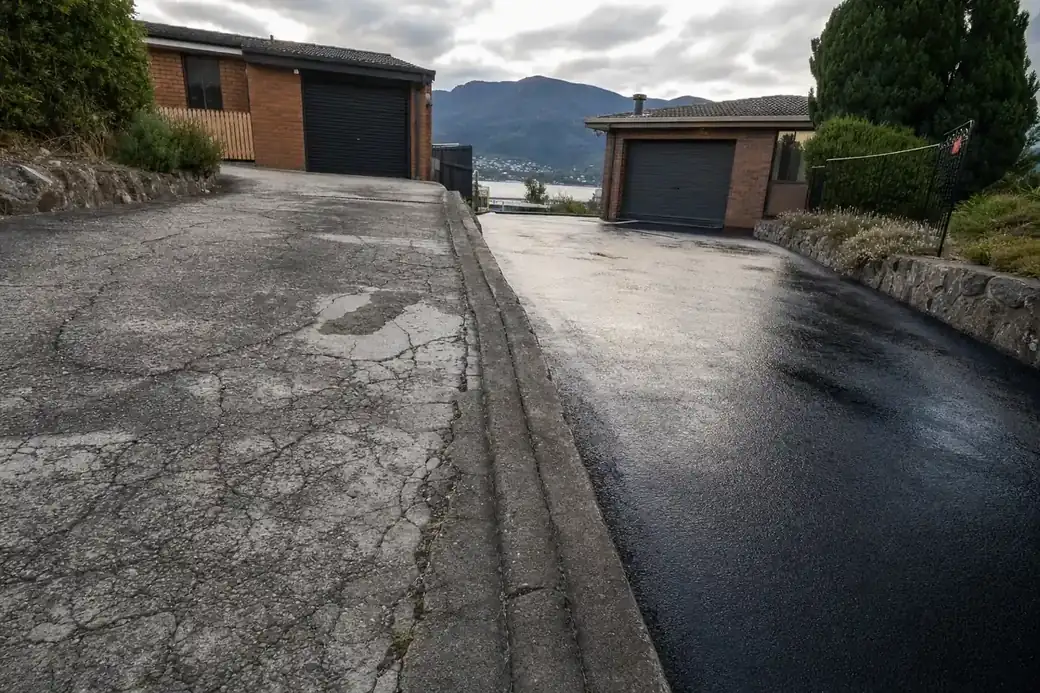
When the driveway starts looking rough, the question isn't just how long before it fails, it's what level of repair does it genuinely need. A driveway that needs a $400 seal coat doesn't need a $6,000 replacement. A driveway that needs a full strip-out will reject any overlay you put on it inside 18 months.
The diagnostic process takes 10 minutes and a walk around your property. Read this, then go outside and work through it.
The three repair levels side by side
| Repair | Approx cost/m² | Life added | When it applies |
|---|---|---|---|
| Seal coat | $3-8 | 5-7 years | Surface oxidation, hairline cracks, general fading |
| Crack fill + seal coat | $5-12 | 5-7 years | Cracks up to 3mm, base structurally sound |
| Overlay (25mm) | $30-45 | 10-15 years | Surface failure, sub-base still sound |
| Strip-and-replace | $60-90 | 20-25 years | Base failure, rutting, widespread cracking |
Check 1: What do the cracks look like?
Hairline cracks under 1mm wide are normal surface oxidation. A seal coat fills and waterproofs them. Cracks between 1-3mm with no vertical movement on either side, crack-fill treatment first, then overlay. Cracks wider than 3mm, or any crack with a step up or down on one side, indicate base movement. Overlay won't fix a base that's still moving.
Crack pattern tells you something about origin
Alligator cracking, that network of small interconnected cracks that looks like scales or broken china, means the base has failed under repeated load. Patching individual squares won't help because the whole area has lost base support.
Straight longitudinal cracks that run parallel to the edge of the driveway usually mean edge restraint has failed. Strip-and-replace is overkill here; saw-cut the edge, rebuild the edge support, and overlay.
Crack type reference guide
| Crack type | Description | Likely cause | Treatment |
|---|---|---|---|
| Hairline / map cracking | Surface crazing, under 1mm wide | Normal surface oxidation | Seal coat |
| Medium cracks 1-3mm | Visible but no step between edges | Surface or upper base stress | Crack fill + seal or overlay |
| Wide cracks 3mm+ | Open, may have vertical step | Base movement | Strip-and-replace |
| Alligator / fatigue cracks | Interconnected web pattern | Base failure from sustained load | Strip-and-replace |
| Edge cracks | Parallel to driveway edge | Edge restraint failure | Edge rebuild + overlay |
| Transverse thermal cracks | Perpendicular to drive axis | Temperature cycling | Crack fill + seal coat |
Check 2: Is there rutting in the tyre tracks?
Stand back and look along the driveway in the late afternoon light. Can you see depressions where the tyres run? Water pooling in those channels after rain confirms it. Rutting means the sub-base has settled or was never compacted adequately. No overlay will fix the cause, strip-and-replace is the only real repair.
Check 3: What do the edges look like?
Walk the perimeter of the driveway and look at the edges. Are they still sharp and sitting flush against the concrete or garden border? Or are they breaking away into the grass and gravel? Crumbling edges mean the sub-base under the edge was never properly restrained. An overlay won't restore edge support; it just puts a new skin over the same unsupported edge.
Check 4: Surface colour and texture
Asphalt fades from black to grey as the bitumen binder oxidises over years. A driveway that's uniformly grey and dry-looking but shows no cracking or distortion is an ideal seal coat candidate. The seal refreshes the binder, darkens the surface, and adds another 5-7 years of protective life for a fraction of an overlay cost.
When grey means oxidised vs when it means aggregate loss
Grey-only oxidation: the aggregate is still tight in the surface, no loose stones, no surface pitting. Seal coat. Aggregate loss: small stones coming loose, pitting, rough texture underfoot, the binder has degraded to the point it's releasing aggregate. This is past seal coat stage; an overlay is the right call.
Check 5: Pothole count and distribution
An isolated pothole in an otherwise sound driveway can be squared off and patched, then the surface sealed. Multiple potholes distributed across the driveway, especially in the middle of the surface rather than just at the edges, indicate widespread base failure. Patching them individually is throwing money at a strip-out situation.
Age alone doesn't tell you what a driveway needs. A 15-year-old driveway on a good base might need a seal coat. A 7-year-old driveway on a poor base might need a full strip-out.
The decision: putting it together
- Faded grey colour, no cracks above 1mm, no rutting, no edge loss → seal coat
- Cracks 1-3mm, surface texture breaking up, base still solid → crack-fill then overlay
- Cracks 3mm+, vertical movement, rutting in tyre tracks, edges crumbling → strip-and-replace
- Mostly good surface with one or two isolated potholes → patch then seal coat
- Alligator cracking over any significant area → strip-and-replace, overlay won't hold
Get a second opinion before committing to strip-and-replace
A full strip-out is the most expensive repair. Before committing to it, get a second contractor to assess the base condition. Honest operators recommend the cheapest treatment that actually solves the problem. If two independent contractors say strip-out, trust them.
Timing your repair in Hobart
Seal coat and overlay work is seasonal in Hobart. The surface needs to be above 10°C and dry for seal coat to bond. The ideal window is October through April. Hobart's June-August period brings rain, low temperatures and frost, seal coat applied in those conditions won't cure properly.
Strip-and-replace has a wider window because asphalt can be laid as long as the ground temperature is above 5°C. But base prep is harder in a wet Hobart winter, so bookings in the June-August period tend to be lighter and lead times shorter.
Cost of delay
A driveway at seal coat stage left untreated for two more seasons becomes an overlay job. An overlay job left untreated for three more seasons becomes a strip-out job. The scale-up in cost at each level is significant, a $400 seal coat delayed becomes a $4,000 overlay, which delayed becomes a $7,000 strip-and-replace.
That's not a sales pitch for urgency, it's the actual pattern we see on repeat call-back jobs. Maintain early and cheaply, or replace expensively later.
Special cases: what changes the decision for Hobart driveways
Most driveway assessments follow the five-check logic above. A few Hobart-specific situations change the calculus.
Steep driveways in South Hobart, West Hobart and Battery Point
Sloped driveways fail at the bottom edge first. Water from the slope concentrates at the lower kerb or garden edge and wicks into the sub-base from below. What looks like an edge seal coat candidate may be a drainage problem that a seal coat won't address.
On any driveway with a grade above 1:8, we check the lower edge drainage before recommending a repair level. If water is pooling at the bottom after rain, a drain channel installation belongs on the scope before the surface treatment.
Heritage suburbs: Council review on full strip-outs
In Battery Point and designated heritage precincts, a full driveway strip-out and replace can trigger a heritage review, particularly if the driveway material changes (concrete to asphalt, or asphalt to a different material). This isn't a reason to defer the repair, but it's a reason to confirm with the City of Hobart heritage team before starting demolition.
Driveways adjacent to the Derwent or tidal creeks
Some Hobart properties along the Derwent foreshore or adjacent to tidal channels, parts of Sandy Bay, Lindisfarne, Bellerive, sit on fill or reclaimed land with variable sub-base conditions. Seal coat on these properties may mask rising damp that's degrading the base from below. We probe the base depth and check for moisture before recommending any treatment.
Seal coat is not a substitute for drainage repair
We see this regularly on Kingston and Bellerive properties after a wet winter: seal coat applied over a driveway where the real problem is stormwater undermining the edge. Six months later the edge is worse than before the seal coat because the water had nowhere to exit. Fix the drainage, then seal.
After the repair: how to keep the surface longer
Once the driveway is repaired to the right level, a few habits extend the result.
- Keep gutters and downpipes clear so roof water doesn't flow across the driveway and undercut the edges
- Don't park a caravan or boat trailer in the same spot on a young asphalt surface, rotate the position to distribute point loading
- Seal oil spills promptly, petrol and diesel degrade bitumen binder over time if left sitting
- Schedule the next seal coat before the surface starts cracking, not after
- Clear leaf litter from the edges in autumn, wet leaves hold moisture against the asphalt and accelerate oxidation