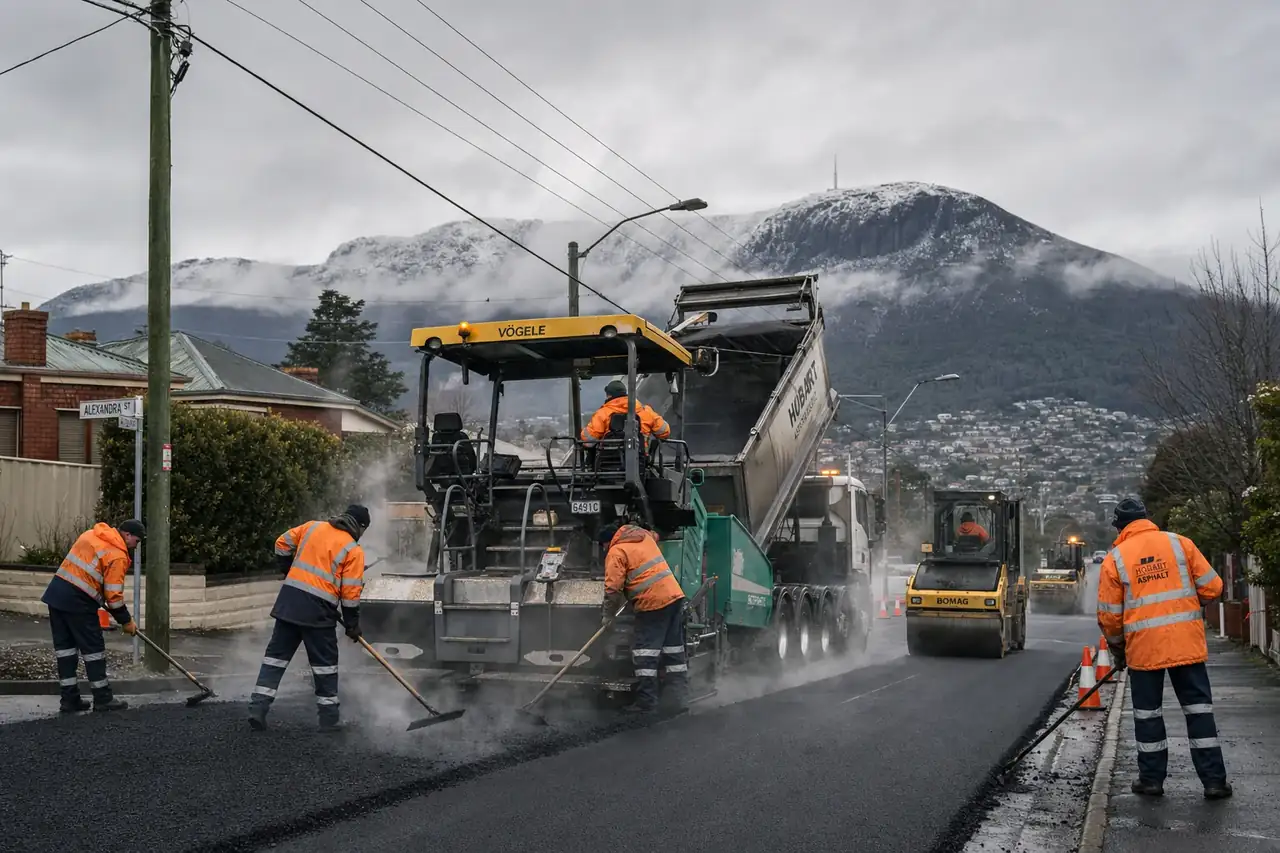
The asphalt you walk on is the wearing course. It's 30-50mm thick and its job is to be smooth, waterproof, and take the daily punishment of vehicle traffic. The structural work happens in the layer below it.
When we see Hobart driveways fail prematurely, and we see it regularly, the cause is almost never the asphalt itself. It's the foundation it was laid on. The asphalt cracks or ruts because something moved underneath it.
This guide covers what a correctly built sub-base looks like in Hobart conditions, what the shortcuts look like, and how to tell whether yours was done properly.
What sub-base is made of
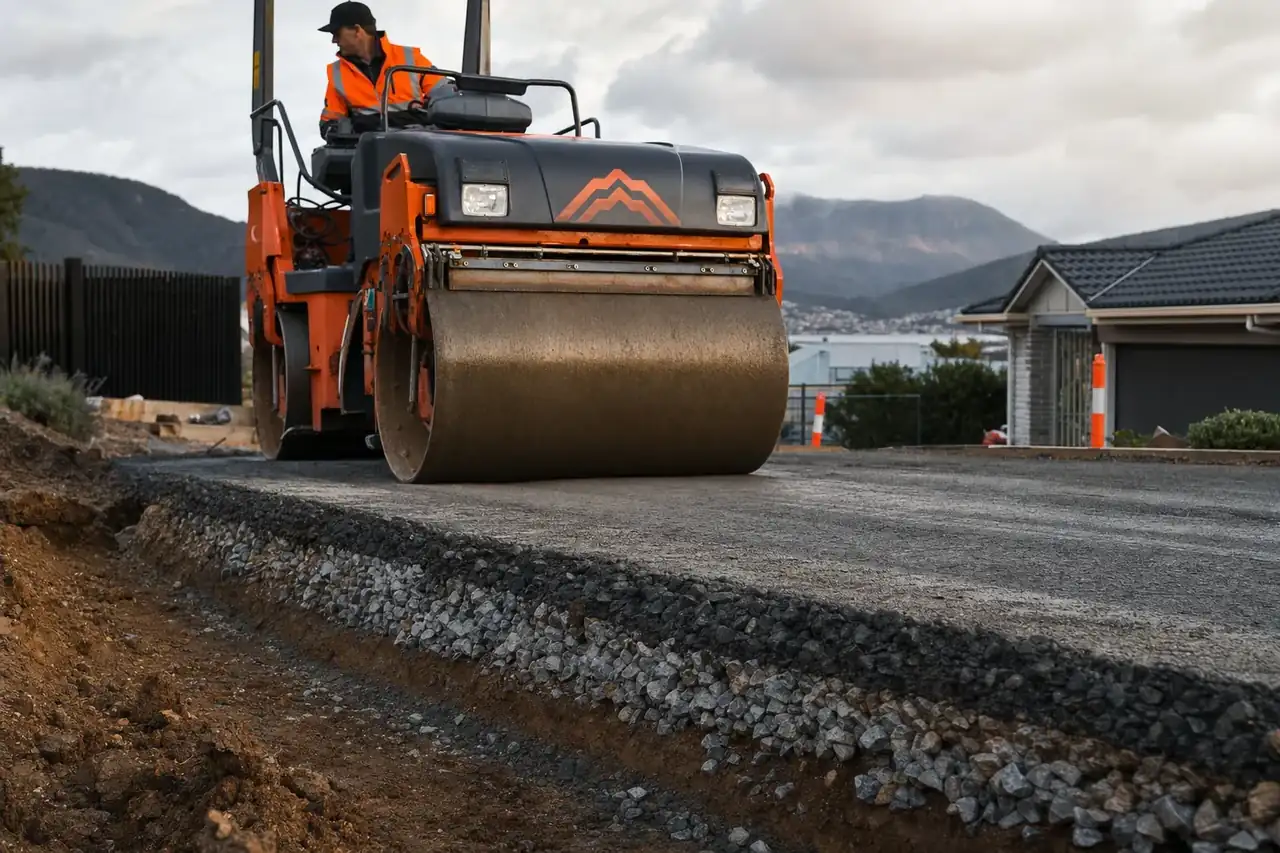
Sub-base in Hobart is typically locally quarried crushed dolerite or sandstone fines, called FCR (fine crushed rock) in the trade. It gets placed in layers over the prepared subgrade soil, then mechanically compacted with a vibrating roller until it reaches approximately 95% of its maximum dry density.
That compaction step is what transforms loose gravel into a stable structural platform. Skipping it, or doing it in one thick pass instead of multiple 75mm lifts, leaves you with a base that continues to compact under the weight of vehicles after the asphalt is already on top.
FCR vs recycled crushed concrete
Virgin FCR from Tasmanian quarries is the benchmark material for residential driveways. Recycled crushed concrete (RCC) is cheaper, widely available from Hobart demolition jobs, and acceptable for light residential in most circumstances.
Where RCC becomes a risk is on reactive clay sub-grades. The fines in RCC are more variable than virgin FCR and can break down in wet Hobart winters faster than quarried material. For commercial carparks or any site with ute-level axle loads, we specify virgin FCR.
How thick does it need to be?
| Use case | Sub-base depth | Asphalt thickness | Notes |
|---|---|---|---|
| Standard residential driveway | 150mm compacted | 30-40mm AC10 | Suits passenger vehicles, standard Hobart block |
| Driveway with regular ute or tradesperson's van | 175mm compacted | 40mm AC14 | AC14 handles commercial axle loads better |
| Residential with caravan or boat trailer | 175-200mm compacted | 40-50mm AC14 | Caravan nose weight concentrates load on the hitch point |
| Small commercial carpark | 200mm compacted | 40-50mm AC14 | Multiple vehicles parked continuously |
| Council-grade road patch or heavy commercial | 250mm+ compacted | 50mm AC14 or heavier | Requires engineer sign-off on spec |
What the AC10 and AC14 designations mean
AC10 and AC14 refer to the nominal maximum aggregate size in the asphalt mix, 10mm and 14mm respectively. AC10 produces a finer, smoother finish and is the right call for standard residential driveways. AC14 has larger stone for better interlocking strength and is used where heavier loads or higher surface durability is required.
Neither designation tells you much about quality on its own. The compaction spec, the bitumen content, and the laying temperature all matter as much as the mix designation. Always ask for the mix spec and compaction standard in writing.
The compaction process, what it looks like on site
A properly compacted sub-base is built in lifts. FCR is placed 75mm deep, the vibrating roller makes multiple passes (minimum 3-4 forward and reverse), the surface is checked for soft spots, and then the next 75mm goes down.
If you watch a contractor dump road-base to full depth in one go and then run a roller over it once before the asphalt truck arrives, the base spec hasn't been met. Polite way to check: ask how many lifts they're doing.
Ask to see the roller
A plate compactor is not a roller. On anything larger than a garden path, the compaction spec for a driveway requires a self-propelled vibrating roller, not the plate compactor that fits in the back of a ute. If the contractor shows up with only a plate compactor for a 60m² driveway, the compaction won't meet spec.
What 95% MMDD actually means
MMDD stands for Modified Maximum Dry Density, a standard laboratory compaction test. Achieving 95% of that value in the field means the material has been compacted to 95% of the density it could theoretically reach under controlled conditions.
Below 90% MMDD, the material will continue to compact under traffic load, that's the post-pour settlement that shows up as ruts and depressions. Specifying 95% MMDD and actually achieving it requires proper lift heights, a suitable roller, and the right moisture content in the FCR.
Signs of a well-built sub-base
- Surface is flat and dead solid underfoot once compacted, no give, no soft spots
- After heavy Hobart rain, water runs off rather than sitting on the surface
- After 12 months, no cracking at the joint where the driveway meets the concrete path or kerb
- After 3 years, no rutting in the tyre tracks, no edge crumbling
- After 5+ years, the edges are still sharp and supported
- After 10+ years, no alligator cracking in the middle of the surface
Signs of a poorly built sub-base
Watch for these in the first 1-2 years
Rutting in the tyre track areas after summer heat, depressions where the driveway has settled unevenly, cracking that follows the line of service trenches, water that ponds on the surface after light rain, these are all base failures coming up through the asphalt.
The frustrating truth is that many base failures aren't visible until the second or third year. The asphalt is stiff enough in the first year to bridge minor voids. As traffic continues and the base settles, the asphalt loses support and the surface cracks or depresses.
Failure pattern as a diagnostic tool
| What you see | Most likely cause | Repair level |
|---|---|---|
| Alligator cracking (interconnected web) | Base failure under repeated load | Strip-and-replace |
| Rutting in tyre tracks only | Insufficient base compaction or depth | Strip-and-replace |
| Cracking along the edges only | Edge restraint failure | Edge rebuild + overlay |
| Longitudinal cracks parallel to edge | Insufficient lateral support at edge | Edge rebuild + crack seal |
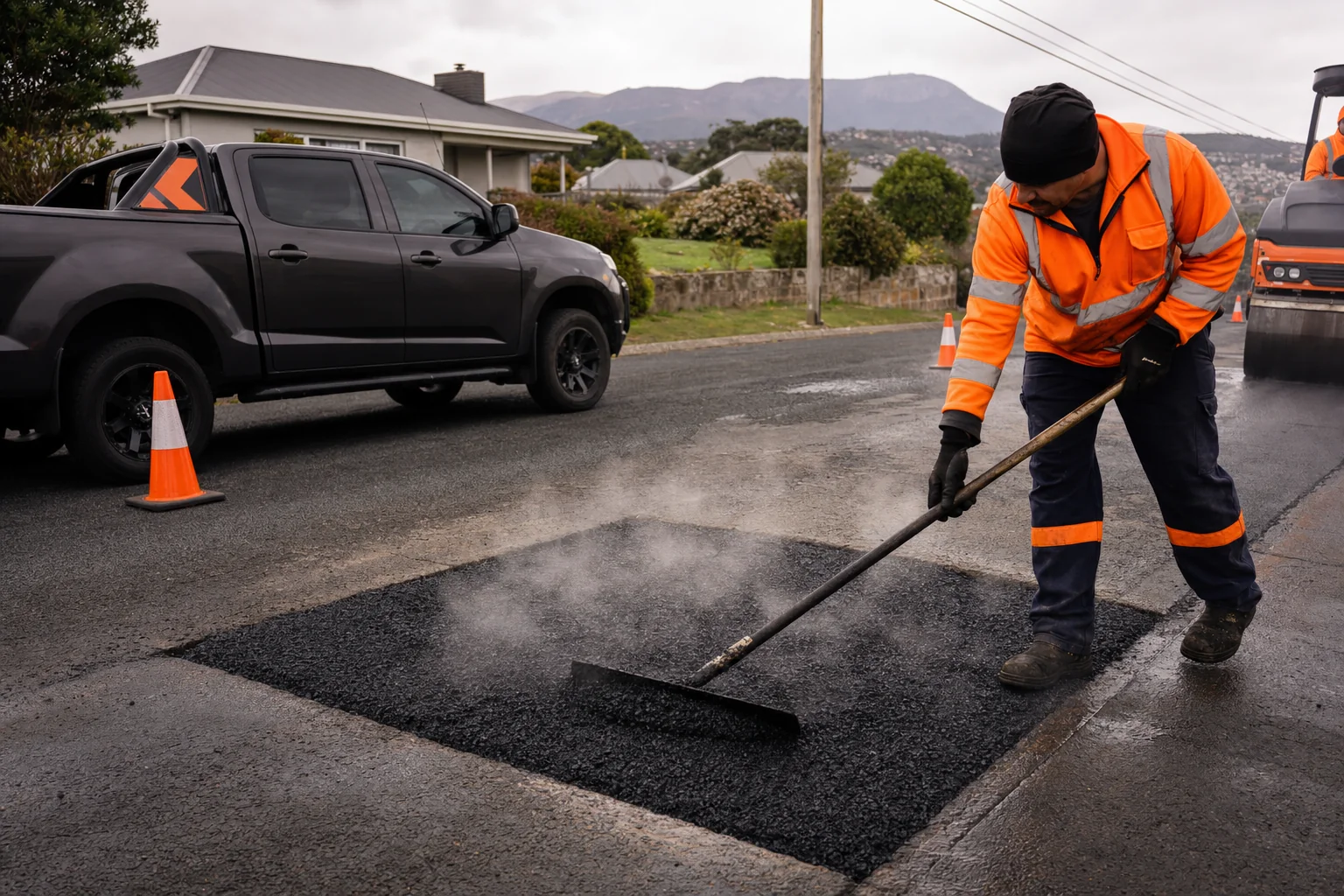
| Potholes in isolated spots | Local base voids or poor patch from previous repair | Patch + seal or targeted overlay |
| Uniform surface craze cracking | Surface oxidation, base still sound | Crack fill + seal coat |
Hobart-specific ground conditions to know about
Southern Tasmania has a mix of subsoil types that affect base design. The dolerite subsoil common across much of greater Hobart is generally stable and good to work with. Reactive clays appear in some low-lying areas around Glenorchy, parts of Clarence, and on infilled land near the Derwent.
On reactive clay, the soil swells when wet and shrinks when dry, creating movement that works upward through the base. On these sites, a geotextile separation layer between the subgrade and the FCR sub-base stops clay fines migrating up into the road-base over time. We assess this at the site visit stage.
Hillside and sloping driveways in Hobart
Greater Hobart has no shortage of steeply sloped residential blocks, particularly in West Hobart, South Hobart, Battery Point, and the slopes below kunanyi. On steep grades, sub-base retention becomes a separate consideration, the base material needs to be contained laterally so it doesn't migrate down the slope over time.
For driveways over a 10% grade, we typically specify a thicker base on the uphill side, concrete kerb and channel on both edges, and sometimes a drainage channel at the base of the slope to intercept water before it undercuts the sub-base at the kerb join.
Edge restraint, the other variable that gets ignored
Sub-base depth gets the attention but edge restraint is equally important to longevity. The edge of the asphalt needs lateral support or it crumbles. A properly built base extends at least 50mm beyond the asphalt edge and includes either a concrete or steel edge restraint, compacted shoulder material, or a concrete kerb and channel.
Questions to ask your contractor before signing off on a quote
- What depth sub-base are you specifying for this site?
- How many compaction lifts will you do, and what size roller?
- What's the material, virgin FCR road-base, recycled crushed concrete, or something else?
- Is a geotextile separation layer needed here based on the soil type?
- What's the edge restraint detail, concrete edge, timber, or compacted shoulder?
- What's the subgrade condition and does it need any prep before base goes down?
Tree roots: an often-overlooked sub-base disruptor in Hobart
Inner Hobart suburbs, North Hobart, New Town, Sandy Bay, South Hobart, have significant street tree canopies and mature garden trees close to driveways. Root systems grow toward moisture and can undermine a sub-base over 5-10 years, lifting sections from below.
When we find evidence of root intrusion on a site visit, cracked edges radiating from a specific point, a lifting section that follows a root line, we recommend root barrier installation before the new base goes down. Without it, the same failure repeats inside a decade.
Root barrier options
- Mechanical root pruning along the driveway edge, effective short-term, doesn't prevent regrowth
- Physical root barrier (deep HDPE sheeting, 600-900mm deep along the driveway edge), stops lateral root growth indefinitely
- Root deflection via kerb and concrete edge, concrete acts as a physical barrier that redirects roots downward
- Chemical root barrier paint (copper naphthenate), applied to cut root ends, inhibits regrowth into the sub-base area
Check with council before pruning street tree roots
Street tree roots technically belong to council. Pruning them without approval can result in a council repair order at your cost. We advise getting written permission from the relevant council before any root pruning adjacent to a street tree, City of Hobart, Glenorchy, and Clarence all have policies on this.
Service trenches and base failure: a specific Hobart problem
Greater Hobart has ageing underground services infrastructure, and trench reinstatements, where telco, water or gas contractors cut through a driveway or road and patch it, are one of the most common sources of premature driveway failure. A poorly reinstated trench settles differently to the surrounding base and creates a stress concentration in the asphalt above it.
If your driveway has a straight-line crack running across it that appeared within a couple of years of any utility work in the area, it's almost certainly a trench settlement crack. The fix is to cut out the failed trench reinstatement, rebuild the base in that section to the correct depth and compaction, then patch and seal.
The sub-base is the boring part of a driveway job, it's all buried and invisible by the time the work is done. It's also the only part that determines how long the visible part lasts.