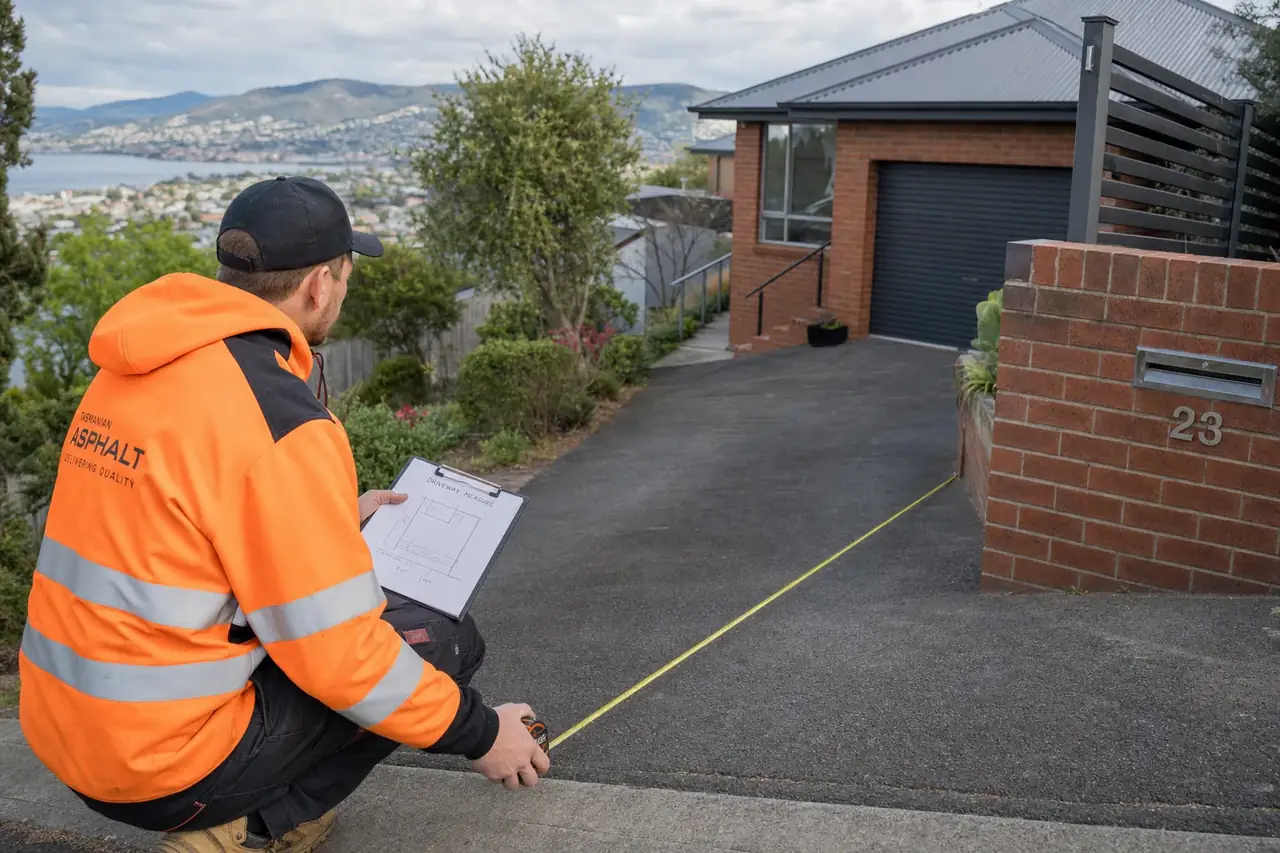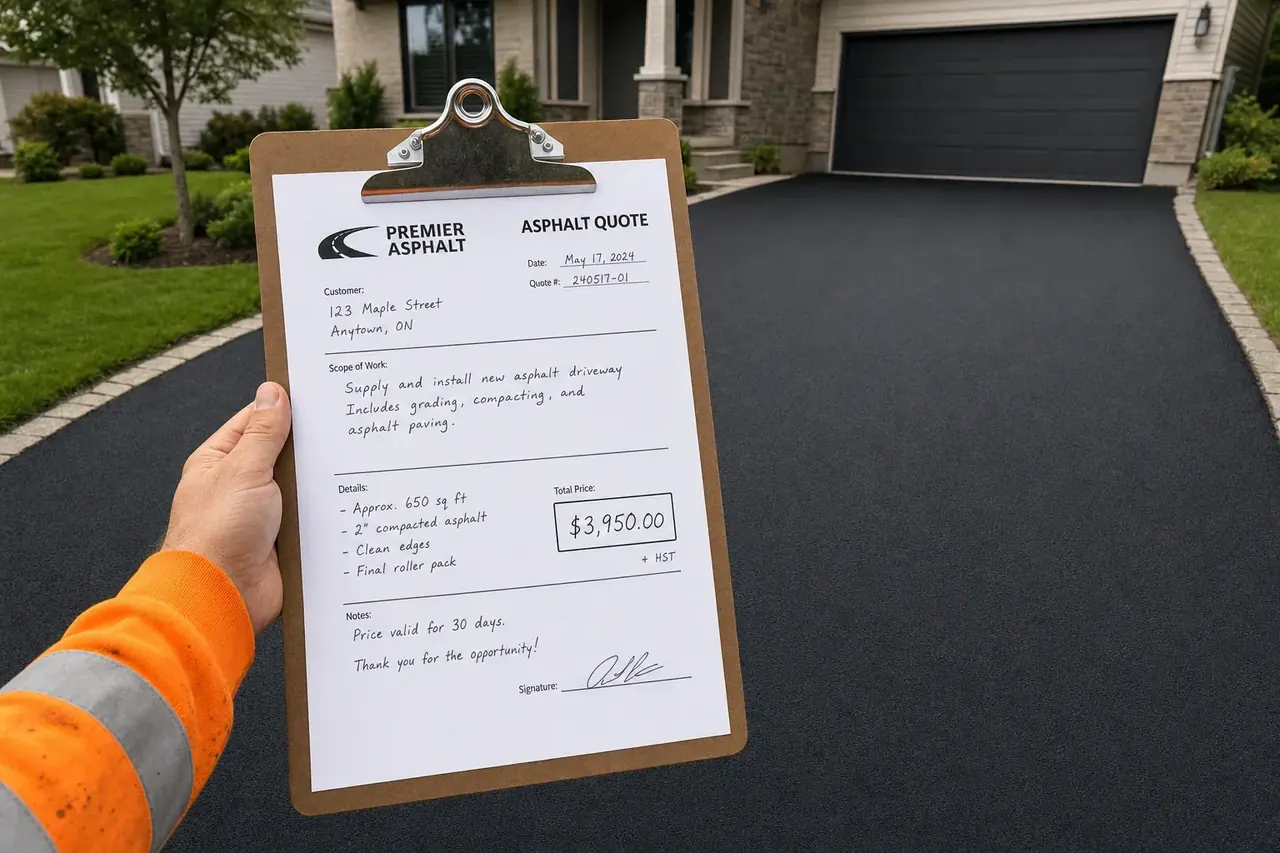
The most common thing we hear when we turn up to quote a driveway is 'I've had quotes from $2,500 to $9,000, how is that possible for the same job?' The answer is that they're not the same job. The quote at $2,500 almost certainly leaves out excavation, specifies half the base depth, and has no edge restraint. The $9,000 quote might include concrete kerb and channel, full strip-out, 200mm base, and a two-year warranty.
This guide breaks down what actually goes into an asphalt driveway price in greater Hobart in 2026, so you can work out what a fair quote looks like for your specific property.
The base cost: per-square-metre installed
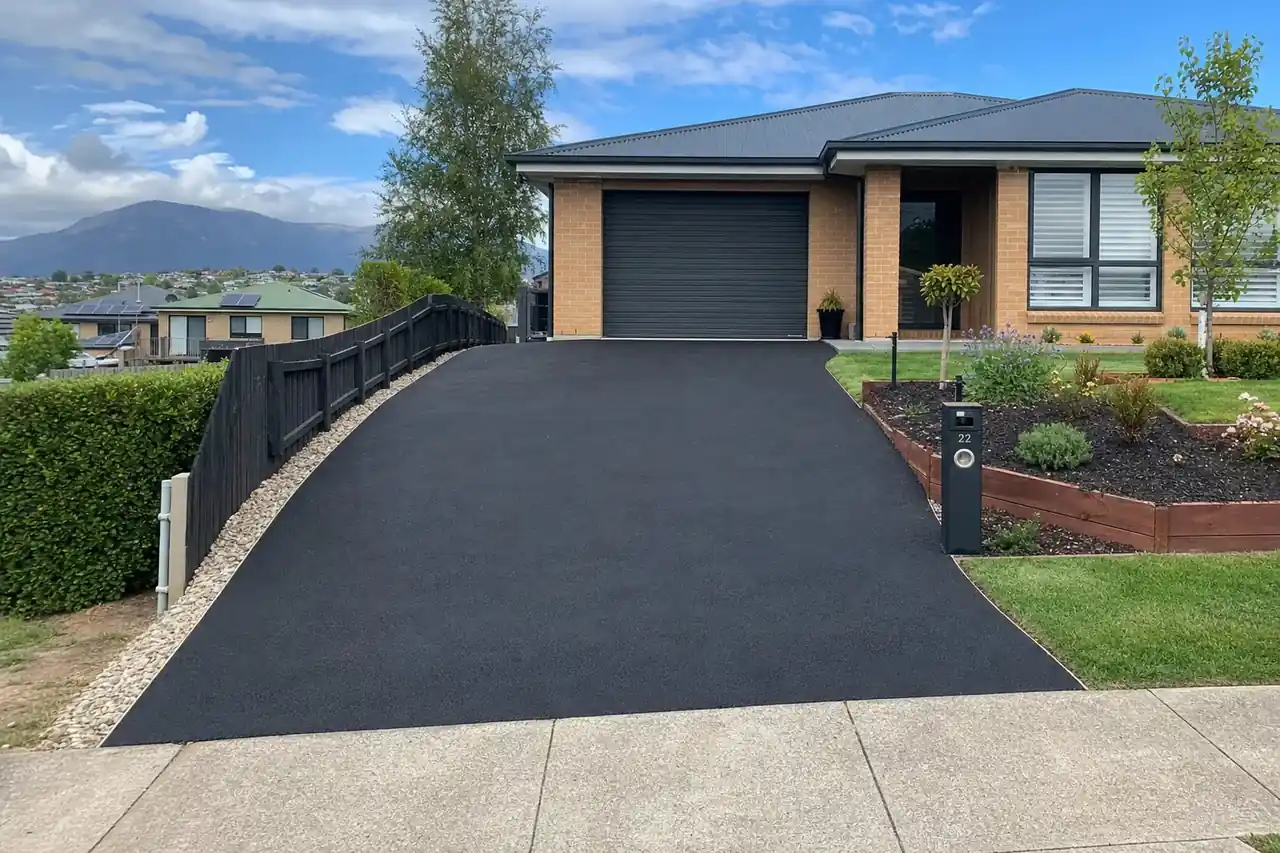
For a standard Hobart residential driveway, flat to gentle slope, reasonable machinery access, existing surface to be removed, 150mm compacted FCR base, 40mm AC10 asphalt, the installed cost runs $50-80 per square metre. That includes material, labour, compaction, and a basic edge treatment.
Simple driveways on flat sites with straightforward access sit at the lower end of that range. Steep blocks, narrow side access for machinery, poor existing base that needs full rebuild, or concrete edge kerb both sides push it toward the upper end or beyond.
| Driveway size | Flat site, basic edge | Moderate slope or access | Steep, tight, or complex |
|---|---|---|---|
| 30m² | $1,800-2,800 | $2,500-4,000 | $3,500-5,500 |
| 50m² | $3,000-4,500 | $4,000-6,000 | $5,500-8,000 |
| 80m² | $4,500-7,000 | $6,500-9,500 | $8,500-13,000 |
| 120m² | $7,000-10,500 | $9,500-14,000 | $12,000-18,000 |
Indicative total installed costs for asphalt driveways in greater Hobart, 2026. Site-specific quotes required.
Factor 1: Slope and drainage
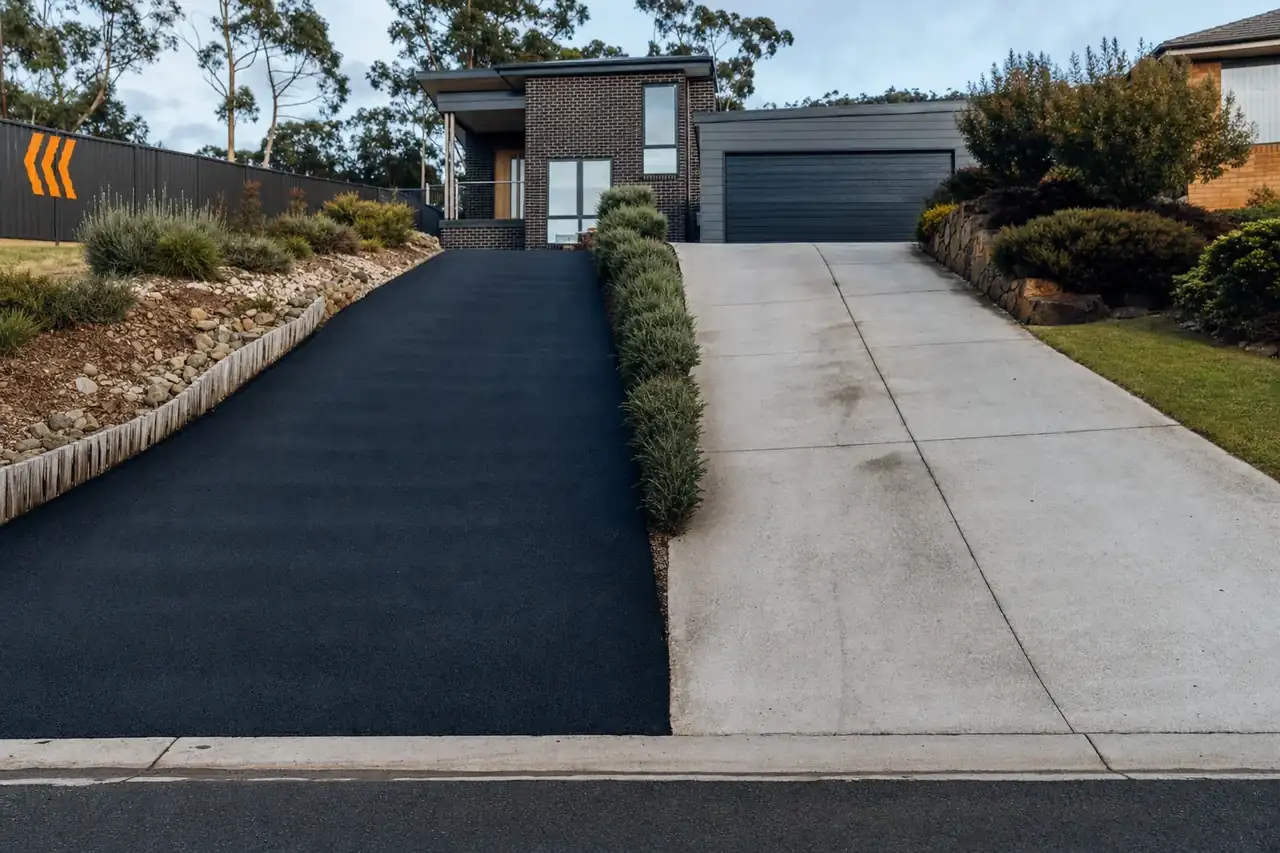
Greater Hobart is hilly. Sandy Bay, West Hobart, South Hobart, Battery Point, Lenah Valley and much of the hillside north of the CBD all have residential blocks on meaningful grades. Sloped driveways need more careful sub-base grading to achieve correct falls, more sophisticated edge containment to prevent base migration, and sometimes a drainage channel at the base of the slope.
A driveway on a 1:10 grade or steeper adds $800-2,500 to a standard job cost, depending on length. The base has to be built differently and the asphalt has to be rolled more carefully to avoid dragging the hot mix.
Drainage design on Hobart hillside properties
Water running off a sloped driveway has to go somewhere. The options are a kerb and channel that intercepts and redirects it to a stormwater pit, a rural drainage swale if the property is large enough, or surface falls designed so water crosses the driveway and exits at the lower edge into a garden or path area.
Getting drainage wrong on a hillside block is expensive to fix retrospectively. We design the falls and drainage points as part of the quote, not something worked out on the day the asphalt truck arrives.
Stormwater on steep Hobart blocks
Some inner-city Hobart properties feed directly into council stormwater infrastructure. If your driveway redirects water away from its approved connection point, council can require you to restore the original drainage path at your cost. We check stormwater approvals on the site visit for any steep-block or heritage-zone job.
Factor 2: Machinery access
Asphalt paving requires a paver machine and a vibrating roller, both of which need room to operate. Standard suburban blocks with a driveway running from the street to the garage are usually fine. Narrow side passages under 2.5m wide, rear courtyard access over a steep step, or properties with low-hanging trees directly over the driveway path require either smaller equipment or hand-laying.
Hand-laying hot mix is slower and costs more in labour. It's also harder to achieve the same surface density as machine-laid asphalt. On constrained sites, a concrete alternative is sometimes the better practical call. We flag this on the site visit.
Narrow access is more common in inner Hobart suburbs
Properties in Battery Point, upper North Hobart and parts of South Hobart often have 1.8-2.2m side passages that are tighter than standard machinery. If your property has a narrow access point, mention it when you call, it affects which equipment we bring and the quote accordingly.
Factor 3: Existing surface removal
If there's already a surface to remove, old asphalt, broken concrete, pavers, gravel, that's a separate cost line. Excavation and removal runs $15-30 per square metre depending on the material and the tip run distance. Old concrete is the most expensive to remove because it needs to be broken up and hauled as heavy rubble.
Some homeowners think their existing gravel or pavers can be left under the new asphalt. In most cases that's a mistake, the existing material needs to be assessed for depth, compaction and drainage before anything goes on top of it. Sometimes it can be re-compacted and used as base; often it's the wrong depth or wrong material and has to come out.
Cost of removing different existing surfaces
| Existing surface | Removal cost approx/m² | Notes |
|---|---|---|
| Old asphalt (loose or broken) | $8-15 | Milled or broken up, often reusable as base fill |
| Sound old asphalt (overlay candidate) | $0 (stay in place) | Assessed for suitability, saves demolition cost |
| Concrete (standard slab) | $18-30 | Requires breaking and heavy haulage |
| Pavers / brick | $12-20 | Some can be salvaged and reused elsewhere on site |
| Gravel (loose, incorrect spec) | $5-10 | Usually scooped and hauled, site-dependent |
Factor 4: Sub-base depth required
Standard residential spec is 150mm compacted FCR. If the subgrade is soft, reactive, or the driveway will carry heavier vehicles, the base needs to go deeper, 175mm or 200mm. The difference between 150mm and 200mm FCR across a 60m² driveway is around $600-900 in material alone, plus additional compaction time.
Sites with known reactive clay sub-soils, common in low-lying areas around Glenorchy and parts of Clarence, also need a geotextile separation layer before the FCR goes down. That adds $3-6 per square metre to the base cost but prevents clay fines from migrating up into the road-base over time.
Factor 5: Edge restraint type
Asphalt without proper edge containment crumbles at the edges within a few years. The options range from a compacted gravel shoulder (cheapest, suitable for driveways against garden beds or open ground) through to concrete kerb and channel both sides (most expensive, most durable).
| Edge restraint type | Approx cost per linear metre | When to use |
|---|---|---|
| Compacted gravel shoulder | $5-12/lm | Driveways against open garden or grass |
| Hardwood timber edge with steel pins | $15-25/lm | Straight residential edges, moderate loadings |
| Steel edge restraint | $20-35/lm | Clean finish against pavers or concrete paths |
| Concrete kerb (half-round) | $35-55/lm | Driveways with guttering or drainage channel |
| Concrete kerb and channel | $50-75/lm | Commercial carparks, sloped driveways, council spec |
What to budget for common Hobart driveway types
A standard 50-60m² Hobart residential driveway on a moderate slope with basic machinery access, full excavation, 150mm FCR base, 40mm AC10 asphalt, and timber edge restraint both sides: budget $5,000-7,500 all-in.
A compact Sandy Bay or Battery Point driveway, 30-40m², steep section, concrete edge kerb, possibly a heritage crossover rebuild: budget $5,000-9,000 depending on heritage requirements and access constraints.
A flat Kingston or Glenorchy driveway, 80m², good access, straightforward base, standard edge: budget $6,500-9,000.
The number on the quote is less important than what it includes. A $5,000 job with the right spec will outlast a $3,500 job on a short base by a decade.
Getting the right quote for your property
We do free site visits across greater Hobart, Sandy Bay, Glenorchy, Kingston, Bellerive, Lindisfarne, North Hobart, West Hobart, South Hobart, Howrah, Rokeby, and everywhere in between. A site visit takes 20-30 minutes and gives us the information we need to quote accurately.
The quote we leave you with specifies the sub-base depth, asphalt mix, compaction standard, edge restraint type, and what's included versus excluded. If you're comparing our quote to others, compare the spec sheets first, not just the bottom line.
Hidden costs to budget for
Some costs are predictable from the quote stage. Others surface during excavation and need to be handled on the day. A well-run job includes a contingency conversation at the quoting stage, the contractor tells you what might add cost if it's found, and what the likely range would be.
| Hidden cost | When it appears | Typical additional cost |
|---|---|---|
| Reactive clay subgrade requiring geotextile | Found during excavation | $3-8/m² additional base cost |
| Shallow underground service crossing the dig area | Found during excavation | $200-600 to redirect or hand-dig around |
| Previous failed base that appeared sound | Revealed when old asphalt removed | $10-20/m² extra base material |
| Council requiring crossover upgrade during permit review | Before construction | $600-1,500 crossover rebuild |
| Heritage survey required by council | Before construction | $300-800 heritage officer review fee |
| Stormwater connection missing or blocked | During excavation | $400-1,200 new pit or connection |
Common scope additions found during Hobart driveway jobs. A good contractor flags these as possibilities at quote stage.
Suburb-by-suburb pricing context
Pricing for the same spec job varies slightly across greater Hobart based on access, mobilisation and the density of jobs in each area at a given time. This isn't price gouging, it's the economics of sending machinery and crew to different parts of the city.
Inner city (Sandy Bay, Battery Point, South Hobart, New Town)
Narrow streets, on-street parking, heritage constraints and steep access all add complexity. Inner city driveways command a 5-15% premium over a comparable flat suburban job. The crossover and heritage review process is also more involved.
Northern suburbs (Glenorchy, Moonah, Claremont)
Flatter terrain, wider street access, and more available staging area means simpler logistics. Lower end of the per-metre range for a given spec. Good sub-base conditions in much of this area though reactive clay pockets exist.
Eastern shore (Bellerive, Howrah, Lindisfarne, Rokeby)
Mixed terrain, some coastal exposure. Salt air from the Derwent slightly accelerates bitumen oxidation, seal coat intervals of 4-5 years recommended rather than 6-7. Good machinery access in most parts.
Southern suburbs (Kingston, Blackmans Bay, Margate)
Longer mobilisation distance from the city adds a modest cost premium. Kingborough-area crossover spec requires 4m minimum width and council inspection, so crossover work tends to be more expensive than equivalent City of Hobart jobs.
Asphalt carpark resurfacing costs vs residential driveways
Commercial carpark resurfacing in greater Hobart follows a different cost structure to residential driveways. The per-square-metre rate is often lower on large carparks because the fixed mobilisation cost is spread across more area, and the work is simpler with fewer edge details.
But carparks introduce different complexity: drainage across a large flat area is harder to get right than on a residential driveway, line marking is a separate cost item, and the base depth requirement is higher because commercial vehicle loading is sustained and heavier.
| Carpark size | Approx overlay cost/m² | Full strip-out cost/m² | Notes |
|---|---|---|---|
| Under 200m² | $38-50 | $70-95 | Small carpark, mobilisation costs significant per m² |
| 200-500m² | $30-42 | $60-85 | Medium, mobilisation cost spread across more area |
| 500m²+ | $24-35 | $50-75 | Large, most cost-effective per m² |
Indicative carpark resurfacing costs in greater Hobart, 2026. Excludes line marking, stormwater pits, and kerb repairs.
Asphalt footpath and pathway costs
Side paths, garden pathways, and private footpaths are common asphalt jobs for Hobart residential properties. They're simpler than driveways, narrower, no vehicle loading, less base depth, and correspondingly cheaper.
A typical 1.2m-wide asphalt garden path runs $45-65 per linear metre installed, including 100mm FCR base and 30mm AC10 wearing course. Curves and multiple direction changes add to the labour component. Paths that meet council footpath standards (1.5m minimum width, accessible gradient, flush transitions) run $55-75 per linear metre.
Combine pathway work with your driveway job
If you're having a driveway laid, ask about adding a connecting side path in the same visit. The asphalt truck is already on site and the roller is available. Adding 15-20m of side path to a driveway job is significantly cheaper than booking a separate mobilisation for the path alone.