Hobart has no shortage of asphalt contractors. Finding a reliable one, not just a cheap one, is where most property owners spend energy they didn't plan to spend.
We've been on the Hobart market long enough to know what the good operators do and what the ones who create callbacks look like. This guide is our honest take on how to vet a contractor, what questions cut through the noise, and what to trust vs what to ignore when comparing quotes.
We'll tell you what to look for when it's not us, because the same checks that confirm we're a credible operator will confirm whether anyone else is too.
Start with insurance and ABN
Before anything else, ask for two documents: a Certificate of Currency for public liability insurance (minimum $10 million cover for residential work) and their ABN. Look the ABN up at abr.business.gov.au and confirm it's active and matches the business name on the quote.
Public liability insurance matters on a driveway job. Heavy plant, trucks, and excavators operate near your property, your vehicles, and sometimes adjacent to fences or retaining walls. If something gets damaged during the job and the contractor doesn't have cover, the cost becomes a dispute. With cover, it's a straightforward claim.
What insurance to ask for specifically
| Insurance type | Why it matters | Minimum cover |
|---|---|---|
| Public liability | Damage to your property, third-party property, injury on site | $10 million for residential work |
| Workers compensation | Covers crew if injured on your property | Required for any business with employees |
| Plant and equipment | Covers damage to or from their machinery | Useful for larger jobs, ask on commercial |
| Goods in transit / professional indemnity | Rarely needed residential, ask on specialist jobs | Project-specific |
Don't take their word for it
Ask for the actual Certificate of Currency document, a current one, dated within the last 12 months. A contractor saying 'yeah, we're insured' without producing the certificate may have lapsed coverage. We carry ours in the quoting folder and hand it over without being asked.
Verify local Hobart experience
Asphalt contracting in greater Hobart has site-specific considerations that don't apply in flat mainland cities. The hills, the subsoil variability, the Derwent-adjacent alluvial soils, the heritage council zones, the steep-block access challenges, these aren't things you learn from textbook asphalt knowledge.
A few questions that reveal whether they've actually worked here vs just set up a website with a Hobart phone number:
- 'What's the sub-base spec you'd use on a steep Sandy Bay driveway?' (Answer should include edge retention and drainage channel reference)
- 'Have you worked in Battery Point recently, and how did the heritage crossover spec differ from a standard Hobart job?'
- 'What soil conditions do you see in Glenorchy that you don't see in the Sandy Bay hills?'
- 'Which Hobart council has the tightest crossover specs in your experience?'
An operator who's been on the tools in Hobart will answer those confidently. One who's based elsewhere and working off a regional call centre won't.
What a legitimate site visit looks like
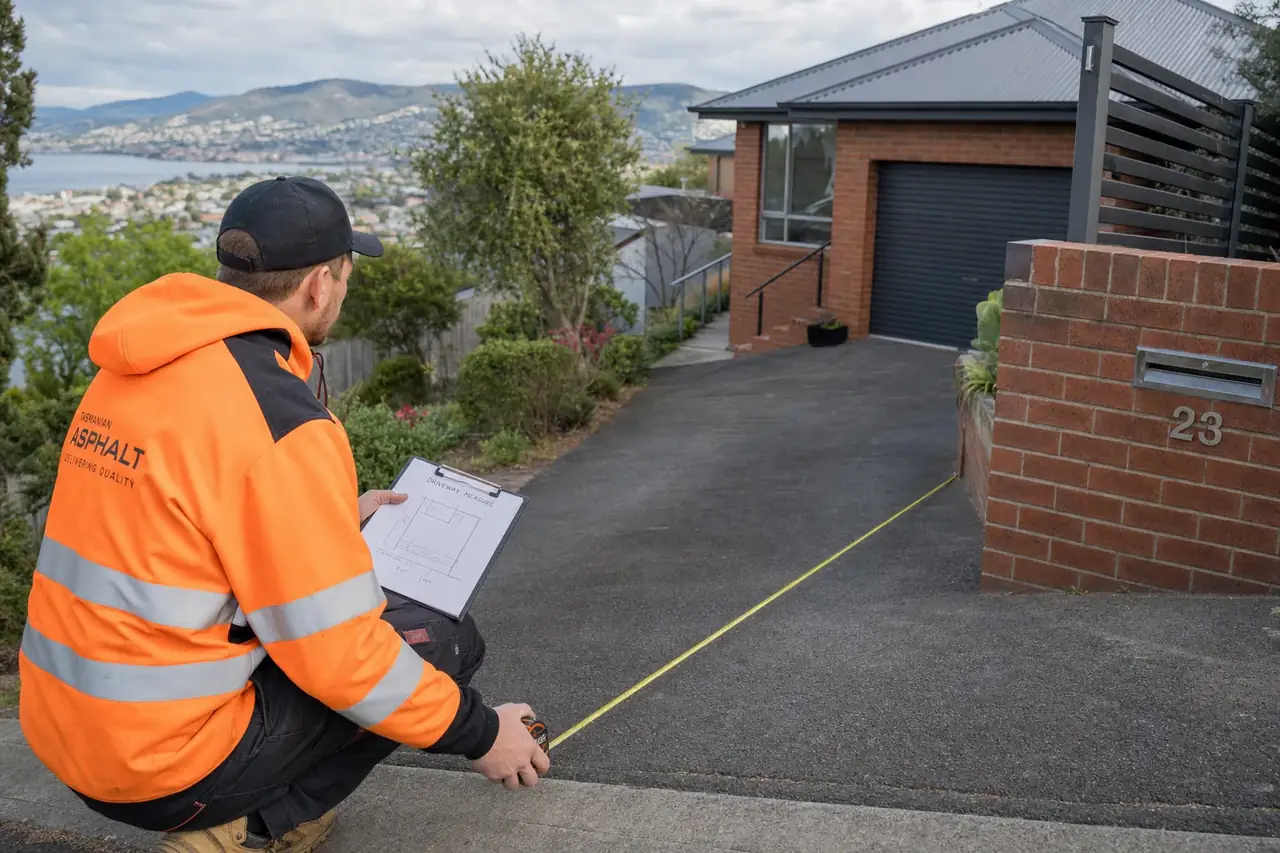
The site visit is the audit. Watching how a contractor conducts it tells you more than any online review. A legitimate site visit includes: measuring the area (tape or laser, not eyeballing it), checking the existing surface and edges, assessing subgrade and soil type at the visible edges, checking access width and overhead clearance for machinery, and asking about stormwater drainage.
They should write things down or enter them into their phone. A contractor who visits your driveway, looks around for five minutes, names a price from memory, and leaves has not done a site assessment, they've done a sales call.
Site visit checklist
- Did they measure the area, or estimate it?
- Did they check the existing base condition and edge quality?
- Did they look at machinery access from the street?
- Did they ask about drainage, where does the water go now, and where should it go after?
- Did they assess the slope and mention how it affects the sub-base design?
- Did they mention service locations or recommend a beforeUdig search?
- Did they leave a written spec with the quote, or just a price?
Ask: what's the riskiest thing about this specific job?
Honest contractors give a real answer. It might be tight machine access on a narrow passage, or reactive soil in one corner, or a heritage crossover spec that needs council sign-off. If they say 'no risk, should be easy' for every job without explanation, they're either not assessing properly or they're telling you what they think you want to hear.
The spec sheet: the document that protects you
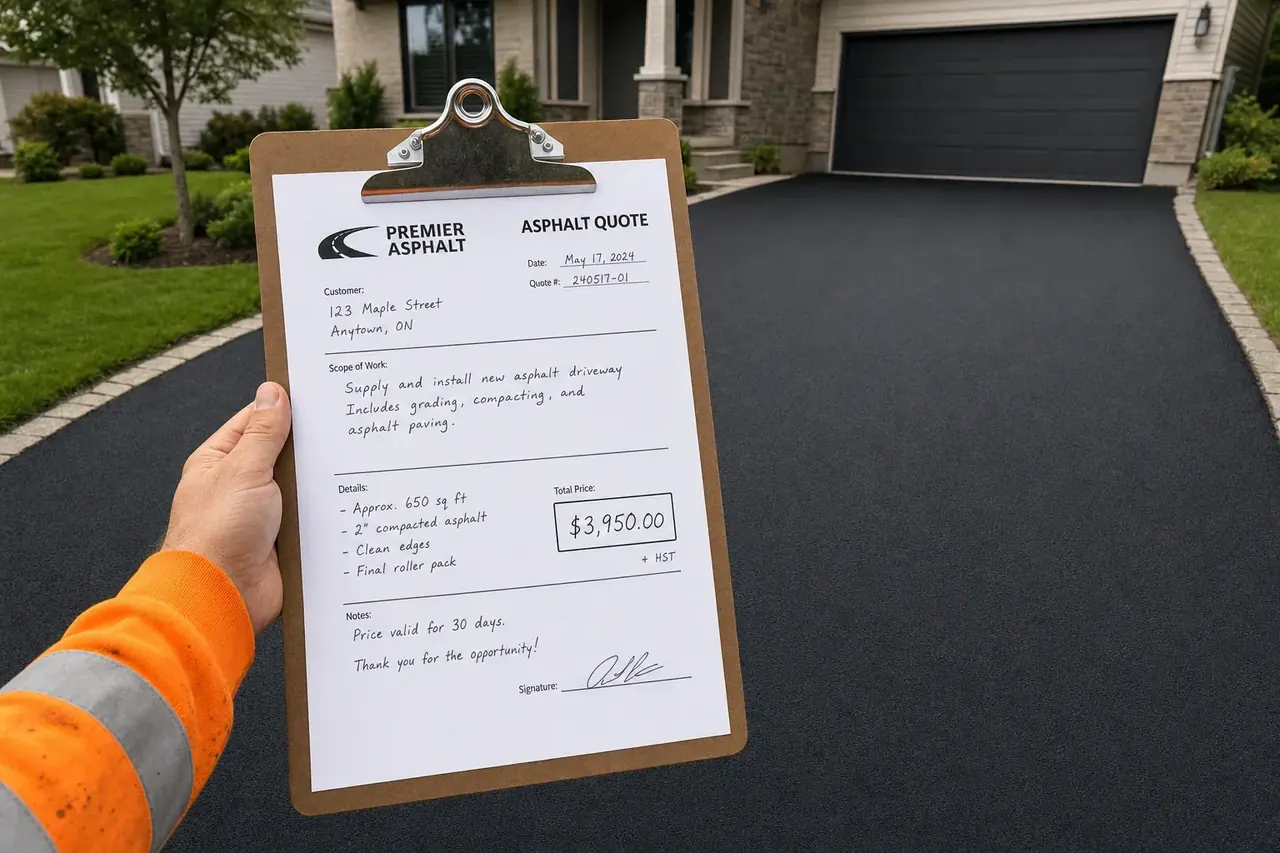
A written spec sheet before any work begins is the document that separates a professional from a punt. It should name the sub-base material and compacted depth, the asphalt mix designation and thickness, the compaction standard, the edge restraint type and location, the drainage falls, and the warranty terms.
If the quote is a single number on a piece of paper, ask for the spec behind it. A contractor who can't produce one in writing either doesn't know what they're planning to build or doesn't want it on paper. Both are problems.
What a spec sheet should contain
| Spec item | What it means | What to check |
|---|---|---|
| Sub-base material | FCR (fine crushed rock) grade and source | Virgin FCR preferred for residential; recycled acceptable for light duty |
| Sub-base depth | Compacted thickness in mm | 150mm minimum residential; 175-200mm for heavy vehicles |
| Compaction standard | % of MMDD achieved | 95% MMDD minimum; ask about roller size and lift heights |
| Asphalt mix | AC10, AC14, or similar designation | AC10 for standard residential; AC14 for heavy use |
| Asphalt thickness | Compacted mm | 30-40mm residential; 40-50mm heavy duty |
| Edge restraint | Type and location | Concrete kerb, steel, or timber, depends on site conditions |
| Drainage falls | Gradient toward stormwater outlet | 1:50 minimum cross-fall to avoid pooling |
| Warranty | Period and scope (surface vs base) | Workmanship warranty in writing; ask about base coverage |
References and how to use them
Online ratings are useful background. A reference call to a recent local customer is worth more. Ask the contractor for two references from Hobart jobs completed in the last 12 months, and actually ring them. Don't just collect the names.
What to ask the reference customer:
- 'Did the job come in at the quoted price, or were there extra charges?'
- 'Did they clean up and leave the site tidy at the end?'
- 'Has anything come up with the driveway in the time since?'
- 'Would you use them again?'
- 'Was the contractor easy to contact when you had questions?'
A contractor who hesitates to provide references, or who only offers references from jobs in other cities, is one to approach carefully. Recent Hobart jobs are the relevant comparison.
Payment terms as a trust signal
Payment structure tells you something about how a business is run. A 10-20% deposit to lock in a start date and cover material commitments is standard in the Hobart asphalt market. Balance on completion, once the work is done to your satisfaction.
Operators who ask for 50% or more upfront are either poorly capitalised (buying materials job-to-job) or aware that their completed work doesn't inspire confidence. Either way, a large upfront requirement shifts the risk onto you.
What payment terms tell you
| Deposit asked | What it usually signals | Your response |
|---|---|---|
| 10-15% | Standard, well-capitalised business | Fine, lock it in |
| 20-30% | Slightly higher but within range | Ask what the balance trigger is |
| 30-50% | Unusual, ask why | Get the reason in writing before committing |
| 50%+ | Red flag, poorly capitalised or history of disputes | Consider whether to proceed |
| Full payment upfront | Strong red flag | Walk away unless you know them well |
Using multiple quotes correctly
Three quotes for a Hobart driveway job is the right number. One gives you nothing to compare. Two creates a binary choice that's hard to resolve. Three gives you a spread that shows where the fair market price sits and flags outliers on both ends.
The comparison should start with spec sheets, not price. A quote 30% cheaper than the other two isn't a bargain if it specifies 100mm base where the others specified 150mm. Work out whether the specs are equivalent first, then compare the numbers.
We'd rather lose a job on price to a contractor who builds it right than win on price and have the driveway come back in five years. The call-back job is the expensive one, for both parties.
How long a quality Hobart asphalt job takes
Timeline expectations are part of what separates good contractors from poor ones. A realistic schedule for a standard 50m² Hobart residential driveway, from site visit to completion, looks like this:
| Stage | Typical duration | What happens |
|---|---|---|
| Site visit and quote | 20-30 min visit, quote within 48 hrs | Contractor measures, assesses, and leaves a written spec |
| Quote acceptance and booking | 1-4 weeks to start (spring/summer) | Deposit paid, date locked, materials ordered |
| Excavation and base prep | Day 1: 4-6 hrs for 50m² | Old surface removed, subgrade prepared, FCR placed and compacted in lifts |
| Asphalt laying | Day 1 or 2: 2-4 hrs for 50m² | Tack coat applied, paver lays mix, roller compacts in passes |
| Edge finish and cleanup | 1-2 hrs same day | Edges tidied, debris cleared, site left clean |
| Curing before driving | 24-48 hrs (cold weather: 48 hrs) | No vehicle access, let the surface harden fully |
Typical timeline for a 50m² residential asphalt driveway in greater Hobart.
Most standard Hobart residential driveways are a one-day job. The base prep and the asphalt pour can often be done on the same day when ground conditions are right. On sites needing more excavation, base-dry time, or council inspection, the job may spread across two days.
What drags a job out
- Wet ground after rain, sub-base needs to drain before asphalt goes down
- Services found during excavation, hand-digging around them takes time
- Council inspection required for crossover work, adds a day wait between build and sign-off
- Heritage review if required, adds weeks before construction can begin
- Access constraints requiring smaller equipment, more time per square metre
What the job site should look like on completion
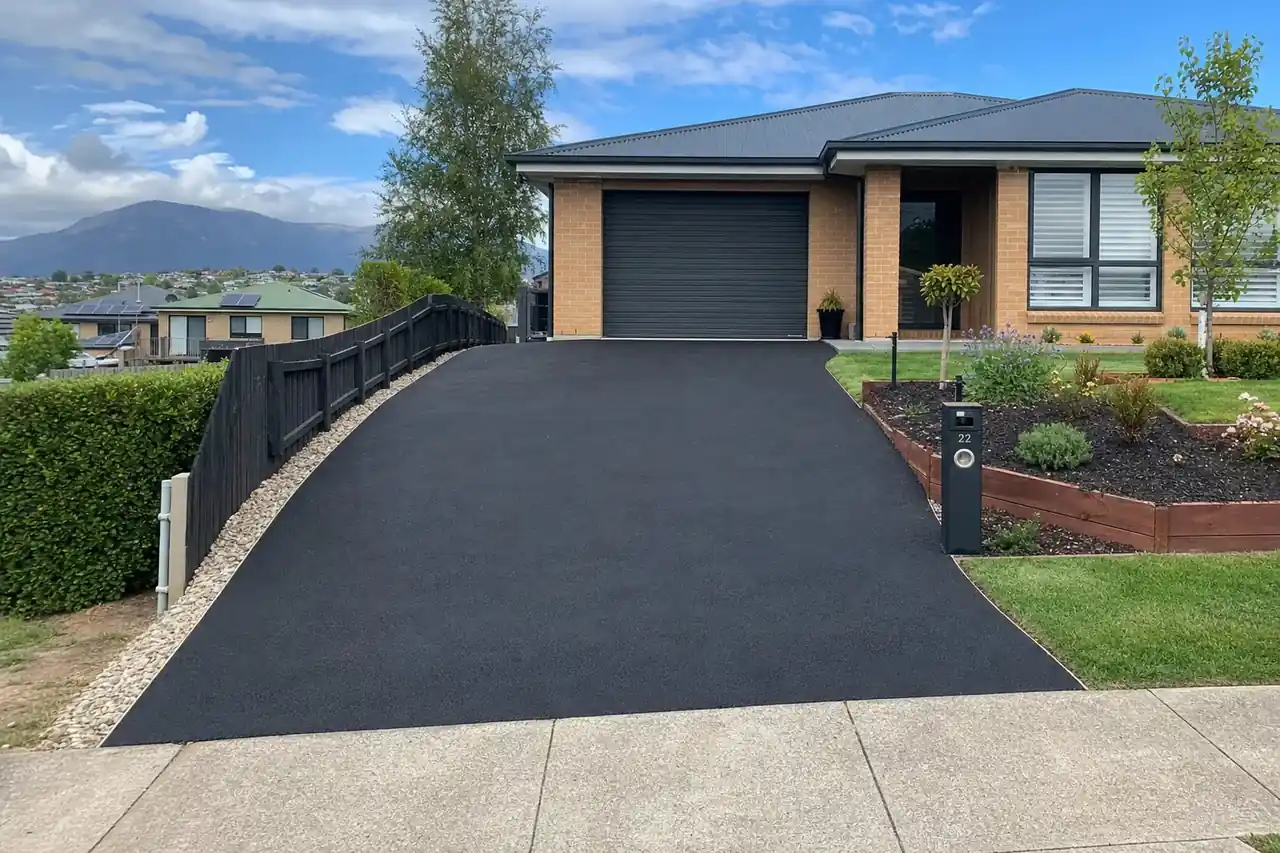
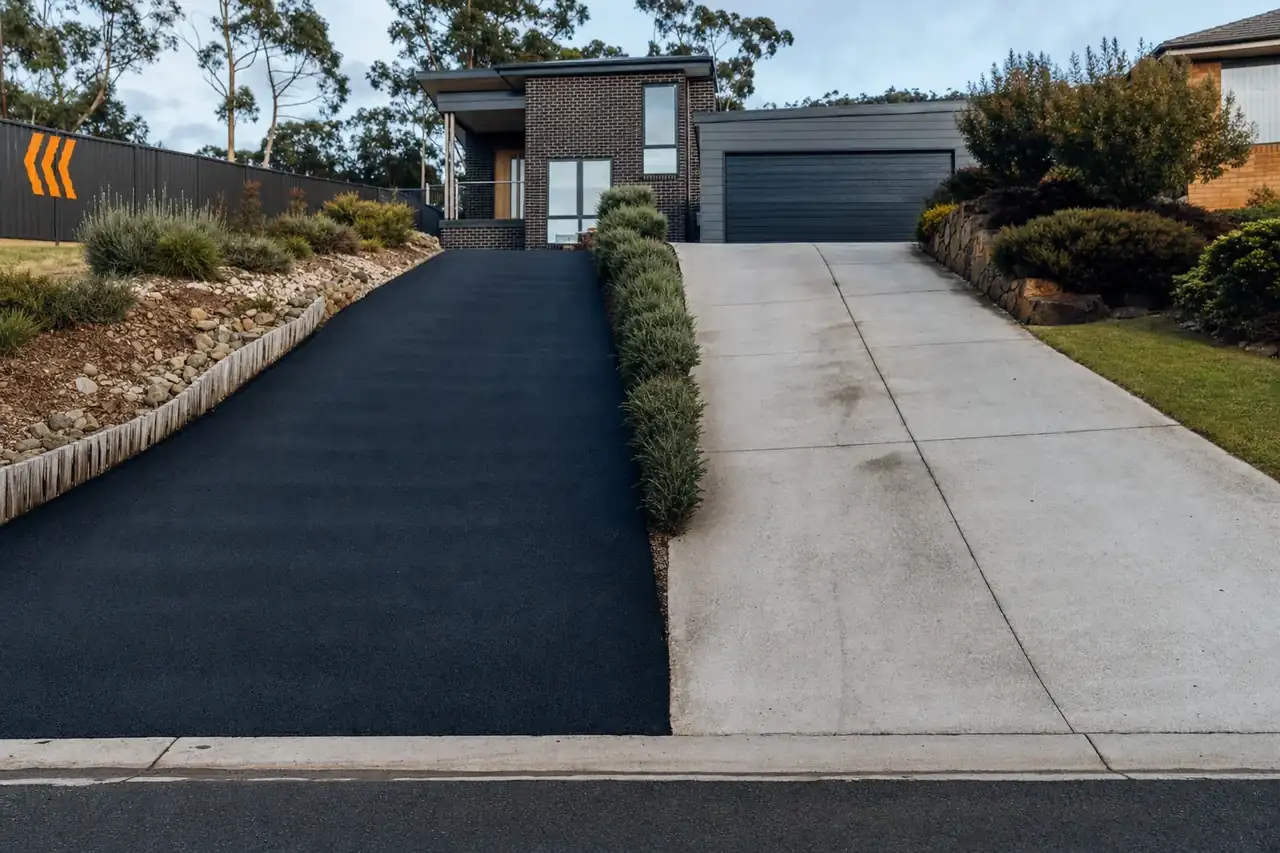
A professional job finishes clean. The driveway surface is tight and smooth, the edges are straight and supported, there are no excess material piles left on the footpath or garden, and the contractor has swept or blown debris off the adjacent footpath.
The surface should have a uniform texture from edge to edge. Any joins, where the new asphalt meets an existing surface, should be as flush as possible, with no lip that could cause a trip hazard or water entry point.
- No loose aggregate left on the surface (indicates insufficient compaction or cold mix)
- Smooth roller-pattern texture, no tyre drag marks from roller turning on fresh surface
- Consistent colour across the full area, no patches where the mix arrived cold
- Edges tight against the edge restraint, not pulled away or crumbling
- Correct drainage falls, water should run off, not pool in the centre
- Site cleaned of all material off-cuts, packaging and debris
What to check 24-48 hours after the job
Walk the driveway the next morning before you drive on it. Look for any soft spots by pressing with your foot, there should be none. Check that the edges are still tight against the restraint. Look along the surface in raking light for any uneven areas. If you have concerns, photograph them and contact the contractor before driving on the surface.
Green flags: what a good contractor does
- Produces insurance certificate without being asked
- Measures the area and asks about soil conditions on the site visit
- Mentions what specific Hobart condition makes your job different from a standard job
- Leaves a written spec sheet with the quote, not just a bottom line
- Gives references who you can actually call
- Names the compaction standard and mix grade if you ask
- Is honest about what the job might reveal once excavation starts
- Provides a 30-day quote validity period and doesn't pressure a same-day decision
Red flags: what a poor one does
- Provides a quote from a satellite photo without visiting
- Can't name the mix spec or compaction standard when asked
- Asks for 50% or more deposit upfront
- Gives a price with no spec breakdown
- Pushes for a same-day decision
- Has no verifiable Hobart job references
- Is reluctant to produce an insurance certificate
- Gives a quote significantly below market without a clear reason why