We've quoted driveways, carparks and road patches across greater Hobart for a long time. The number of times we've come second to a cheaper quote and then been called back to fix the resulting mess, it's a pattern we've stopped being surprised by.
This guide covers what a solid asphalt quote actually contains, what the weak ones consistently leave out, and the five specific red flags that should make you put the pen down.
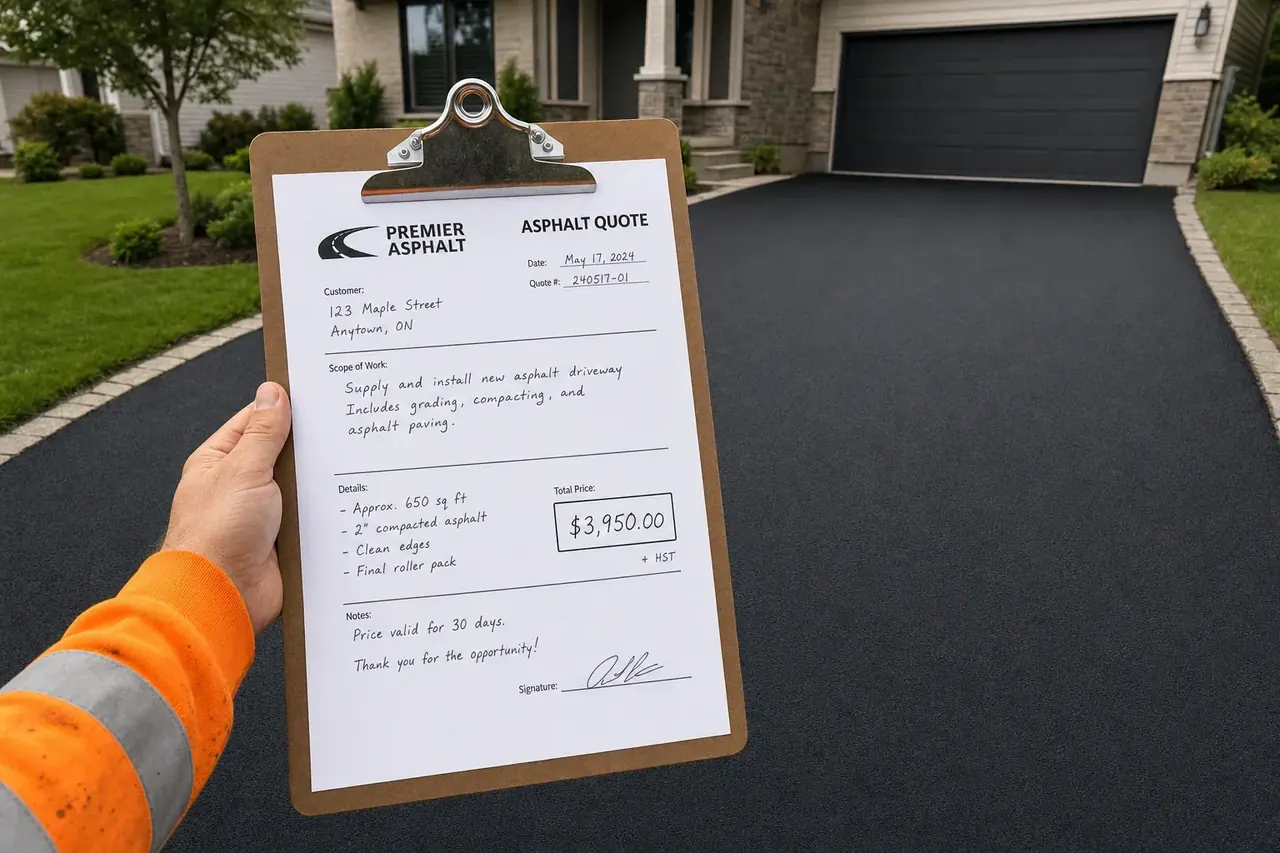
What a good asphalt quote includes
- Itemised pricing: site prep, excavation, base, asphalt supply and lay, edge work, line marking, each broken out separately
- Sub-base material type and depth (e.g. '150mm compacted FCR road-base')
- Asphalt mix specification and compacted thickness (e.g. '40mm dense-graded AC10 wearing course')
- Compaction specification (e.g. '95% MMDD compaction, roller in 75mm lifts')
- Edge restraint detail (e.g. 'concrete kerb on both sides' or 'hardwood timber edge restrained with steel pins')
- Drainage falls specified (e.g. '1:50 cross fall toward road kerb')
- Warranty period and exactly what it covers (surface, base, or both)
- Deposit amount, payment schedule, expected start and completion dates
If the quote you're looking at has a single line item for the whole job, ask for the breakdown. A contractor who won't provide it is either guessing at their own costs or planning to sort out the detail once you've paid the deposit.
What the warranty should cover
A workmanship warranty on asphalt covers defects caused by the contractor's process, insufficient compaction, incorrect falls, poor edge detail. It doesn't cover damage from tree root intrusion, ground movement beyond the contractor's control, or vehicle impacts.
A base warranty goes further, it covers the sub-base preparation as well, meaning if the driveway fails because the base was inadequate, the contractor comes back to fix it at their cost. Ask specifically which one you're getting.
Red flag 1: No site visit
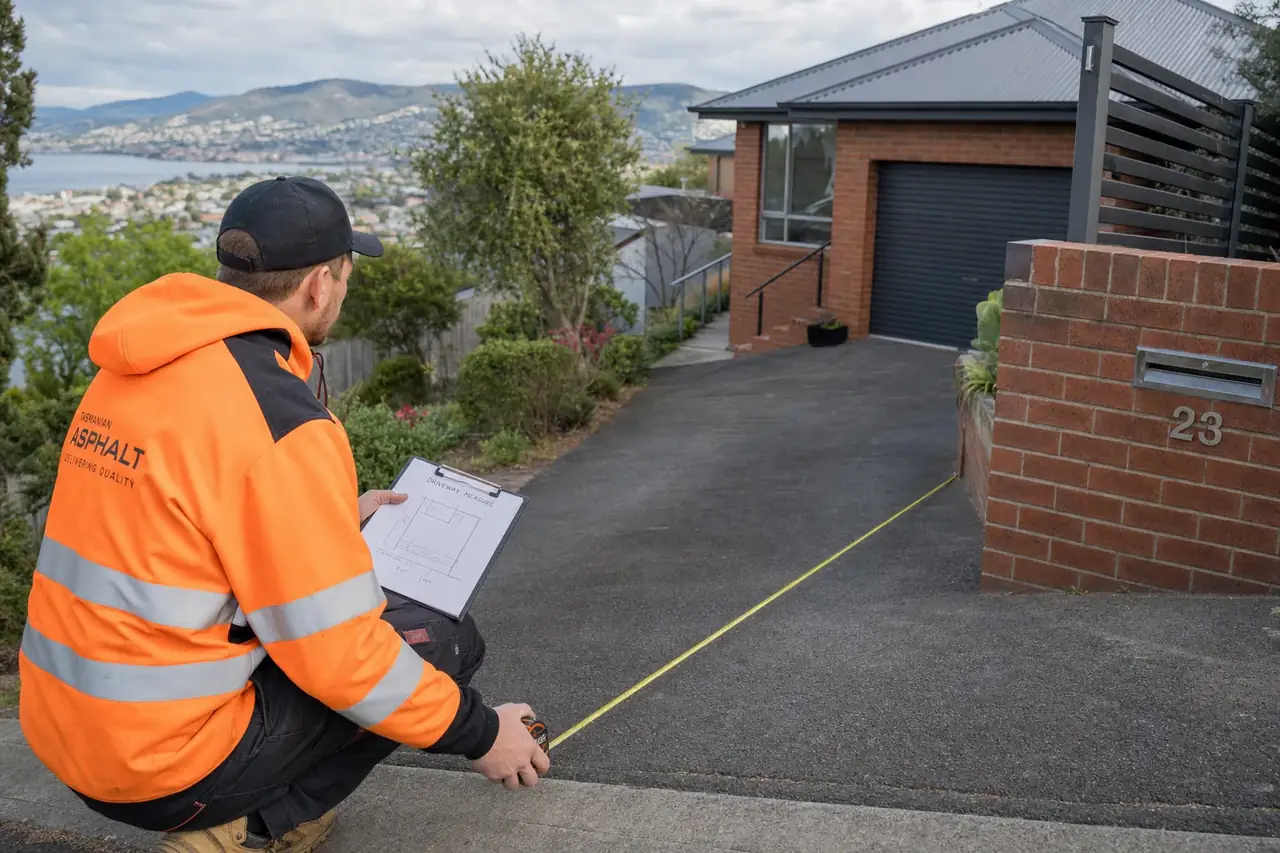
You cannot write an accurate asphalt quote from a phone description or a satellite image. Slope, access for machinery, existing surface condition, soil type, stormwater drainage, edge conditions, all of these move the price. A 'quote' given without a site visit is a placeholder figure that will change, usually upward, once the contractor actually shows up.
A site visit takes 20-30 minutes. Any Hobart contractor serious about the work will come out and look before they price it. Ones who won't are either too busy to care about your job or not confident enough to price what they can't see.
Red flag 2: Vague pricing
Watch out for this pattern
If the quote says 'residential driveway, supply and lay asphalt, $X' with no further detail, that price is a guess. Access difficulty, base prep requirements, drainage, edge work and material grade all move the real figure by thousands on the same square metres. Vague pricing means wrong pricing.
Red flag 3: No written spec sheet
If the driveway fails in three years, what a contractor said on site is worth nothing. A written spec sheet, sub-base depth, asphalt thickness, compaction standard, edge restraint type, is the document you'd use to hold them accountable. No written spec = no accountability. Don't sign without one.
Red flag 4: A large upfront deposit
Industry standard is 10-20% deposit to lock in a start date and cover materials. Some operators ask for 50% or more upfront. Once they have that money, your leverage drops significantly. A 20% deposit puts enough skin in the game to commit a legitimate contractor. Anything above 30% is unusual and worth questioning.
Red flag 5: Pressure to decide today
A 'today-only price' or 'we've got another job available that week if you don't lock it in now' is a sales tactic, not a real scheduling constraint. Good asphalt contractors are busy, but they quote, give a validity period of 30 days or so, and wait. Any contractor pressuring you to sign before you've had time to compare quotes isn't acting in your interest.
Reading between the lines on price differences
If three quotes for the same Hobart driveway come back at $4,800, $7,200, and $9,400, the instinct is to start at the middle. That only holds if all three quotes are on the same spec. The $4,800 quote might spec 100mm base and 25mm asphalt. The $7,200 might spec 150mm base and 40mm asphalt. The $9,400 might spec 200mm base, 40mm asphalt, concrete kerb both sides, and a five-year warranty.
Those are not comparable jobs. The $4,800 driveway on 100mm base in a Hobart hillside suburb will need work in under five years. The $7,200 job done properly might go 20 years without attention. You need the spec to know what you're actually comparing.
| Quote element | Minimum to accept | Red flag |
|---|---|---|
| Base depth | 150mm compacted FCR for residential | No depth specified, or 'sufficient base' |
| Asphalt thickness | 30mm AC10 minimum residential | No mix or thickness specified |
| Compaction standard | 95% MMDD, roller in 75mm lifts | Compacted 'to spec' with no further detail |
| Warranty | Workmanship warranty in writing, 12 months minimum | Verbal warranty only, or no warranty mentioned |
| Deposit | 10-20% of total | Over 30% upfront; full payment before start |
Comparing three quotes properly
- Get all three on the same written scope, same driveway area, same edge work, same drainage spec
- Put the spec sheets side-by-side and compare sub-base depth and compaction standard first, before looking at price
- Adjust mentally for spec differences, a quote with 100mm base versus one with 150mm base isn't an apples comparison
- Read the warranty terms carefully. A 10-year structural warranty from a contractor who's been operating for 18 months is worth less than a 5-year warranty from a business that's been trading for two decades
- Ask all three: 'What's the most likely thing to fail on this job and why?' Honest contractors give real answers to that question
The spec sheet comparison matters more than the price comparison. A thin-base quote at $4,000 and a full-spec quote at $6,500 are not two quotes for the same job.
Questions worth asking before you sign any Hobart asphalt quote
A few direct questions reveal a contractor's competence quickly. Experienced operators answer them without hesitation. Those who are guessing their own spec or working from a price book hesitate, deflect, or give vague answers.
- 'What compaction standard are you building the sub-base to?', Answer should name 95% MMDD or equivalent.
- 'How many lifts will you do for the base?', Answer should say 75mm per lift, not 'one pass'.
- 'What mix are you laying and what's the compacted thickness?', Answer should name AC10 or AC14 and a millimetre depth.
- 'What's the drainage fall across this driveway going to be?', Answer should reference a gradient, e.g. 1:50.
- 'What's covered by your warranty and for how long?', Answer should be in writing, not verbal.
- 'Have you worked on properties like this in Hobart before?', Offer to tell them the address of a nearby job so you can go look at it.
What to do with unsatisfying answers
If a contractor can't answer the first three questions clearly and promptly, ask for time to review the written quote and compare it to the spec checklist above. An inability to name the compaction standard or mix grade isn't always a red flag on its own, not every experienced operator uses the formal terminology in conversation. What matters is whether the spec sheet backs up their words.
If neither the conversation nor the spec sheet has the detail you need, that's the signal. Move to the next quote on your list.
The 30-day quote validity: why it matters
Asphalt material costs are tied to bitumen prices, which track oil markets and can move significantly over weeks. A legitimate contractor sets a 30-day quote validity to protect themselves from committing to a price if material costs move substantially between quoting and starting.
A quote without a validity period can be withdrawn or repriced at any time before you sign, which is fine, but you should know that. A quote with a very long validity (six months or more) may indicate the contractor has priced conservatively to cover possible material cost increases, which can mean you're paying a premium for the buffer.
Standard practice: 30-day validity, clear start date, 10-20% deposit on acceptance. Anything far outside those norms is worth asking about before you sign.
Understanding what a warranty actually covers
The word 'warranty' on a quote means nothing without the specifics. Contractors offer different warranty scopes and the differences matter significantly if something goes wrong.
| Warranty type | What it covers | What it doesn't cover |
|---|---|---|
| Workmanship only | Defects from the contractor's process: incorrect falls, insufficient compaction, poor edge detail | Sub-base failure if spec was met, tree root intrusion, ground movement, vehicle impact |
| Workmanship + materials | Above plus defects in the asphalt mix itself | Ground movement, third-party damage, neglected maintenance |
| Base warranty | Sub-base prep included, contractor liable if base fails due to their spec or compaction | Ground movement outside the contractor's control, pre-existing soil conditions disclosed at quote |
| Comprehensive structural warranty | Full structural liability for the specified period | Rare on residential, more common on commercial projects |
For residential driveways in Hobart, a minimum 12-month workmanship warranty is standard. Better operators offer 2-3 years on workmanship and some include base warranty for residential jobs. Ask specifically what the warranty covers before you treat it as a meaningful protection.