Potholes are the cheapest problem on your property to fix and the easiest one to fix badly. Almost every failed repair we get called back to look at was done with the right intention and the wrong method.
This guide covers how potholes actually form in greater Hobart, why cold patch out of a tub behaves the way it does, and what a hot mix repair involves step by step. It also covers the cases where a DIY cold patch genuinely is the sensible call.
If you only take one thing from it, take this: the preparation decides the outcome, not the material you tip in at the end.
How a Hobart pothole actually forms
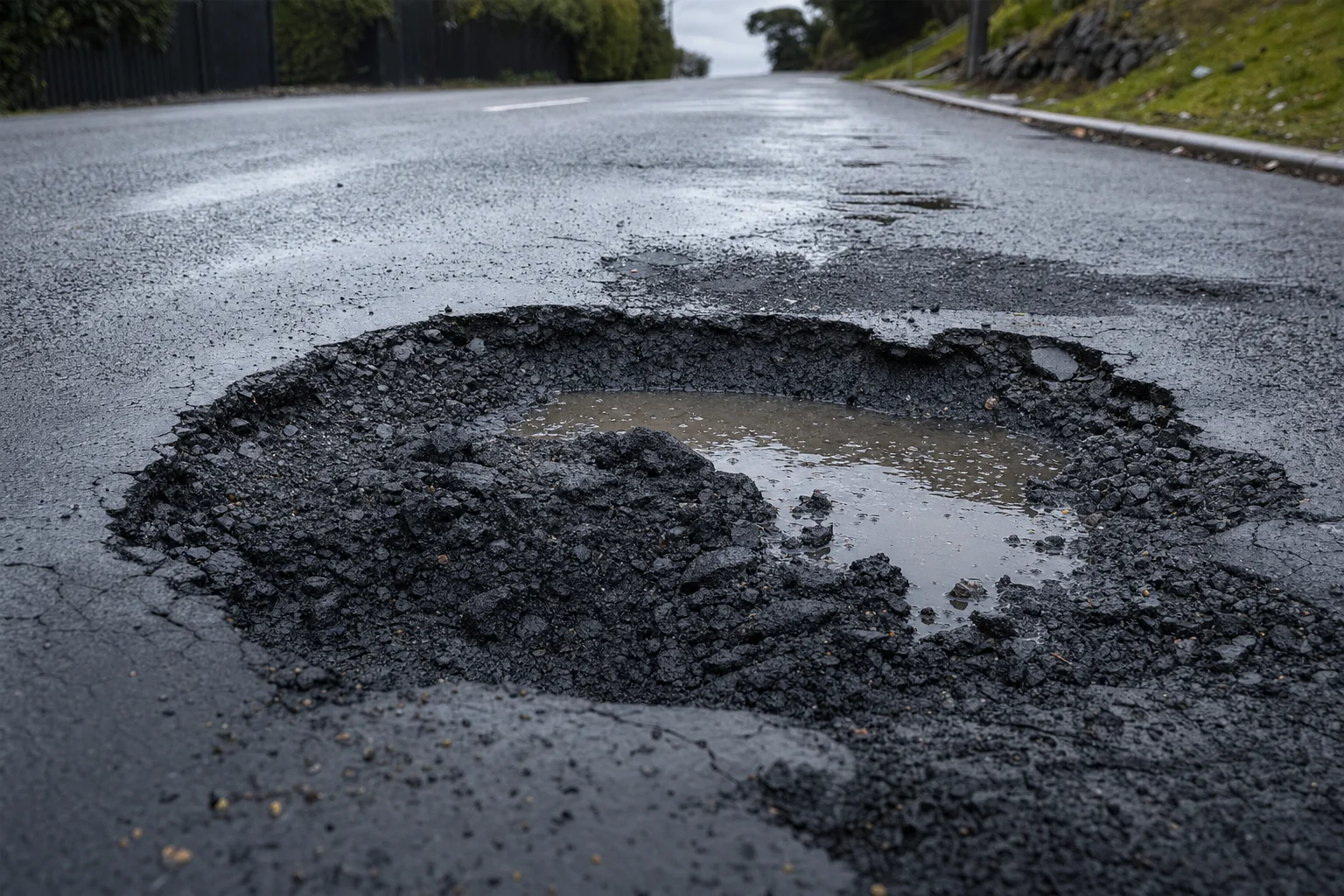
A pothole is almost never a surface problem that started at the surface. It starts as a hairline crack, often a fatigue crack in a wheel track or a joint that opened up where two surfaces meet.
Water gets through that crack and sits in the sub-base underneath. Southern Tasmania gives that water plenty of chances to freeze overnight and thaw the next morning, and every cycle expands the void a fraction more.
Once there is a void under the asphalt, the surface has nothing supporting it. The next vehicle that rolls over it flexes the unsupported asphalt until it breaks up, and what was a crack becomes an open hole in a matter of weeks.
The three ingredients every pothole needs
- A way in for water: a crack, an open joint, a failed trench reinstatement, or a crumbling edge
- Somewhere for the water to sit: a sub-base that holds moisture instead of draining it away
- Repeated load: vehicle traffic flexing the unsupported surface until it breaks up
Remove any one of those three and the pothole does not form. That is why a repair that only addresses the visible hole, and leaves the water path intact, tends to reopen in the same spot.
Cold patch vs hot mix: what actually separates them
Cold patch is asphalt aggregate coated in a binder that stays workable at ambient temperature. It comes in a bag or a tub, you tip it in, tamp it down, and drive on it. It is designed to be convenient, and it is genuinely good at that job.
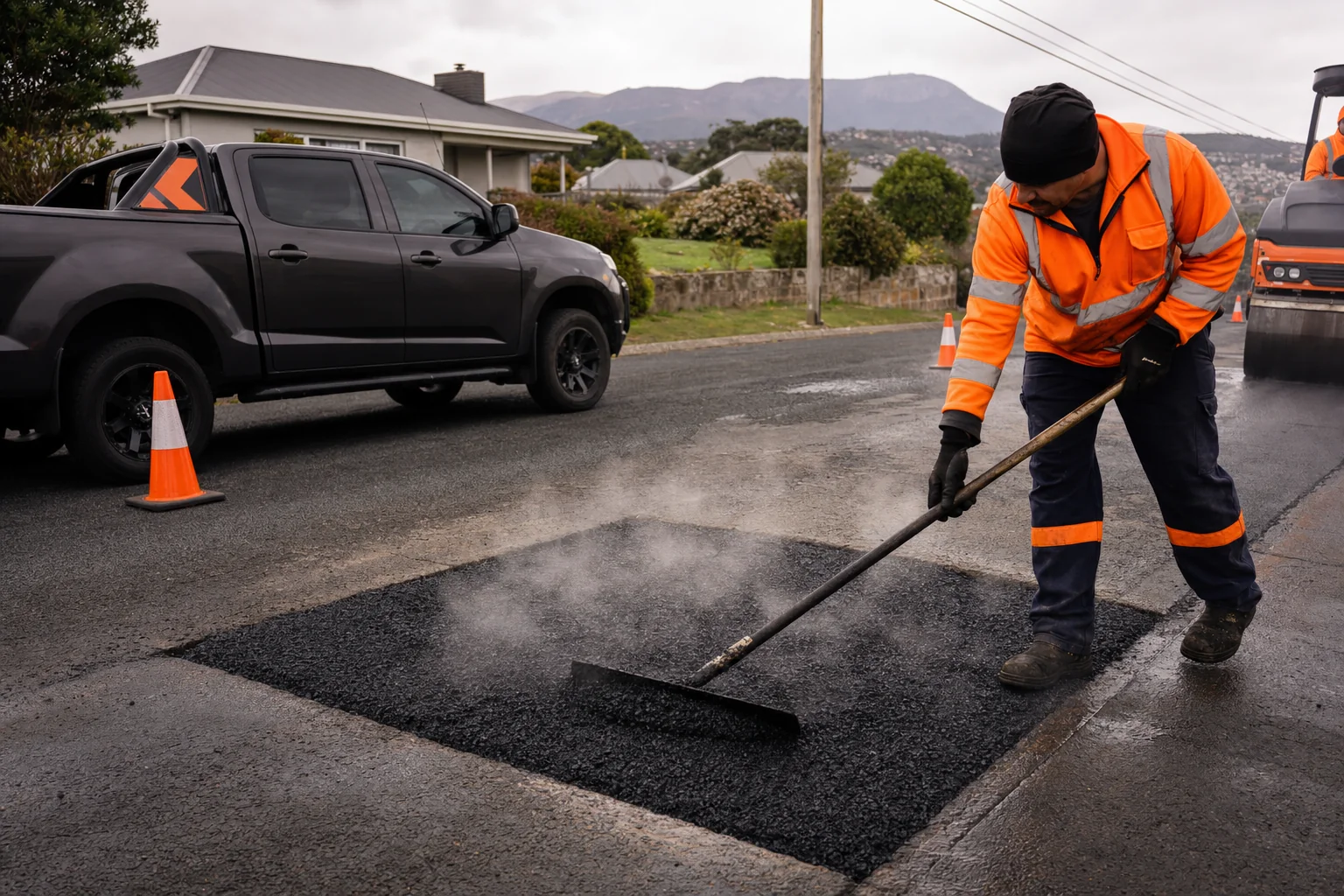
Hot mix is delivered from the plant at temperature, placed while it is still hot, and compacted before it cools. As it cools it stiffens and locks together into a dense, effectively waterproof surface that bonds to the pavement around it.
The practical difference is bonding and density. Cold patch sits in the hole as a separate lump of material, while properly laid hot mix becomes part of the surface it was placed into.
| Factor | Cold patch | Hot mix repair |
|---|---|---|
| Bond to existing pavement | Mechanical only, no chemical bond | Tack coat bonds new mix to cut faces |
| Typical service life | Weeks to a couple of years | 10 or more years when prepared correctly |
| Compaction achieved | Hand tamp, low density, voids remain | Plate or roller compacted, dense and sealed |
| Performance in a wet winter | Poor, water enters voids and pumps material out | Good, dense surface sheds water |
| Edge condition needed | Works in a ragged hole, which is the problem | Needs a square saw cut to firm material |
| Right use case | Temporary hold until proper repair | The permanent repair |
The gap between the two is preparation and density, not just the material temperature.
The tub of cold patch is not the villain
Cold patch does exactly what it says on the packaging. The failures happen when it is used as a permanent repair in a hole that was never squared, cleaned or compacted. Used as a stopgap over a wet fortnight until a proper repair is booked, it is a sensible thing to have in the shed.
What a proper hot mix pothole repair involves
The sequence below is what we do on every pothole, whether it is a single hole in a Kingston driveway or a run of them across a commercial carpark. None of the steps are optional, and skipping any one of them is what produces the callbacks.
- Inspect and measure, checking the surface around the hole for the crack or joint that let water in
- Saw cut rectangular edges outside the full extent of the damage, not just around the visible hole
- Excavate all broken asphalt and any disturbed base material back to firm ground
- Apply a bitumen emulsion tack coat to the cut walls and the base so the new mix bonds
- Fill with hot mix and screed it level, slightly proud of the surrounding surface before compaction
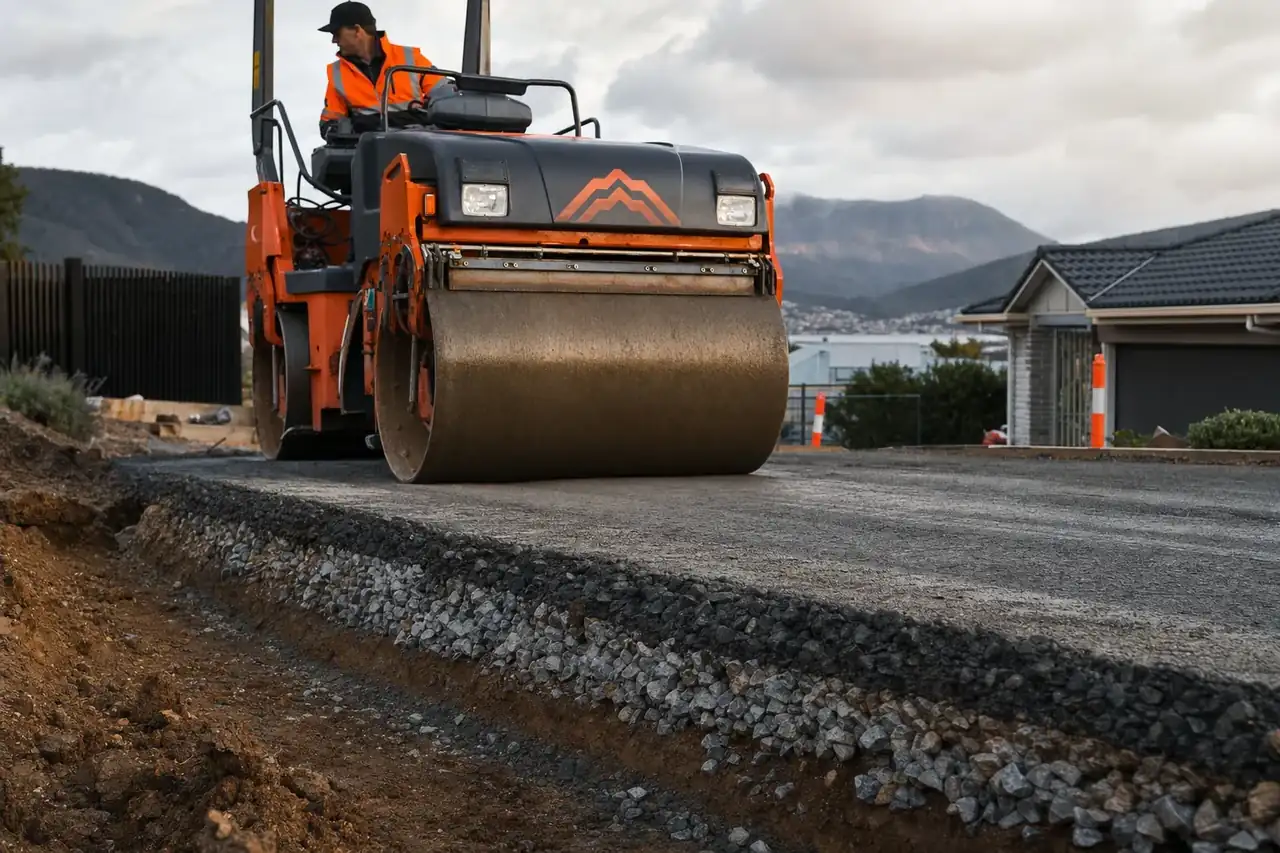
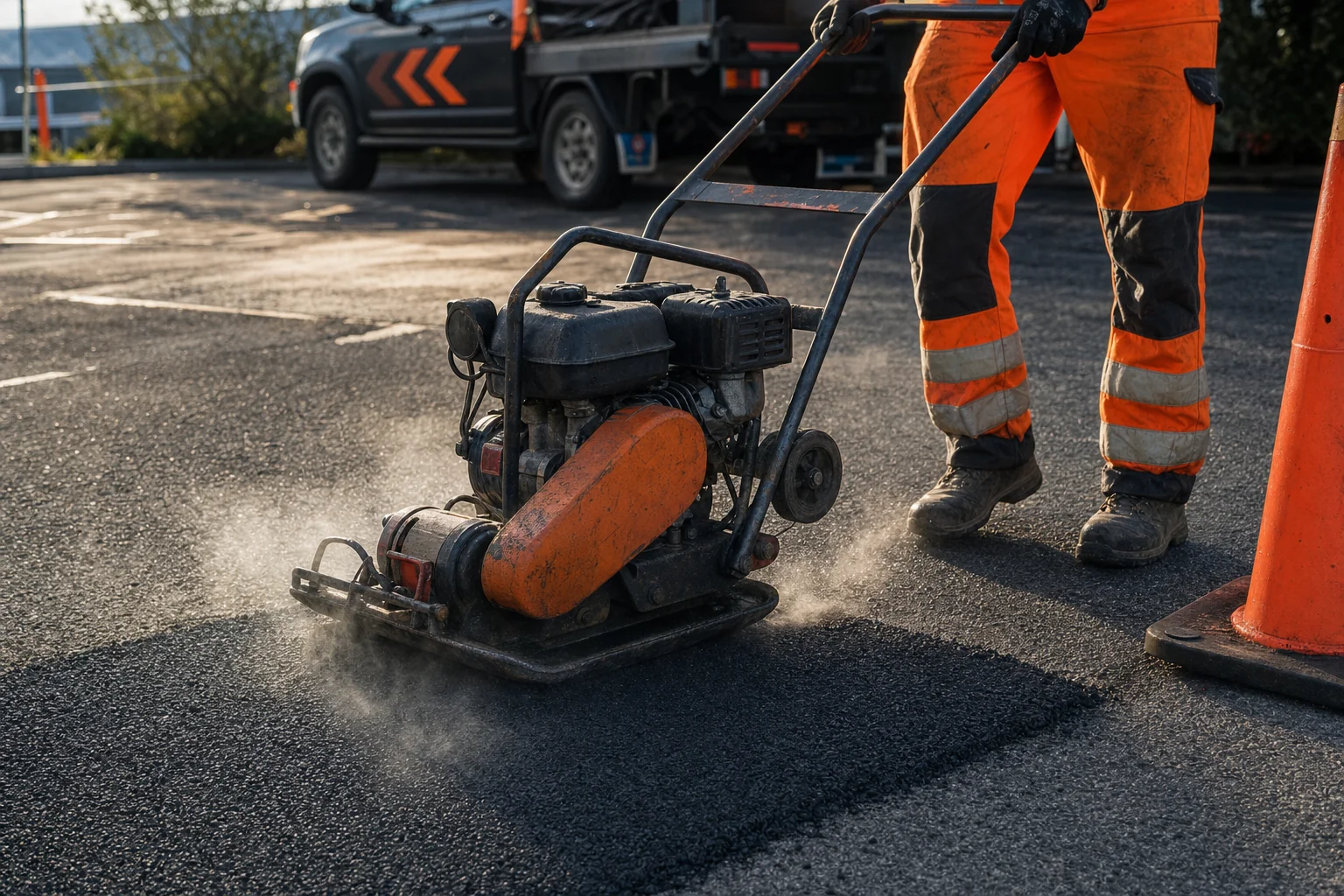
- Compact with a vibratory plate or roller until the patch sits flush
- Seal the joint around the patch perimeter to keep water out of the bond line
Why the square cut does the heavy lifting
A pothole has crumbling, undercut edges. Material placed against those edges is bearing on asphalt that is already failing, so the repair inherits the failure and spreads outward from the rim.
Cutting a clean rectangle back to sound material gives the new mix vertical faces to bond against and a firm shoulder to compact against. It also stops the patch pulling away at the edges under braking and turning loads.
Why the tack coat is not a nice to have
Without a tack coat, the new hot mix is a plug sitting in a hole. It relies on friction alone, and the joint between old and new is an open seam that water travels straight down.
The emulsion glues the two together so the patch and the pavement behave as one surface. When you see a patch that has lifted out whole, leaving a clean rectangular hole, that is a missing or poorly applied tack coat.
When a DIY cold patch is the right call
We are not going to pretend every pothole needs a crew and a truck. There are situations where a bag of cold patch and half an hour is the correct, proportionate answer.
- A small hole on a private driveway that already needs resurfacing next season anyway
- A trip or tyre hazard that needs to be made safe today, with a proper repair booked
- Rural or gravel access tracks where the surface was never sealed to begin with
- Holding a hole through a wet stretch of winter when hot mix cannot be laid well
If you are doing it, give yourself the best chance. Get the hole as dry as you can, scrape out every loose piece, fill in layers of about 25mm rather than one deep dump, and tamp each layer hard before adding the next.
Compact it far harder than feels necessary
Almost every DIY cold patch failure we see is under compacted. Tamping with the end of a shovel is not enough. Drive a car wheel slowly back and forth over the filled patch a dozen times, or hire a plate compactor for the afternoon if you have more than one hole to do.
What pothole repair costs around Hobart
Pothole pricing is driven by patch size, how many patches are done in the one visit, and how far the truck has to travel. Doing several in one booking is always cheaper per patch than calling us back three times.
| Job type | Typical price | Notes |
|---|---|---|
| Small patch under 0.5m² | $250 to $450 per patch | Single hole, standard access |
| Medium patch 0.5 to 2m² | $400 to $900 per patch | Larger area, more excavation and mix |
| Multi patch visit | $300 to $600 each on the day | Better per patch rate when done together |
| Rural travel | Surcharge applies | South of Kingborough or east of Clarence |
| Urgent within 24 hours | 20% premium | Fitted in ahead of scheduled work |
Indicative pothole repair pricing across greater Hobart and southern Tasmania.
There is a minimum call out for very small jobs, which is why batching patches matters. If you have one hole now and two more forming, it is worth waiting a fortnight and doing all three in one visit.
Why the same pothole keeps coming back
A patch that fails in the same spot twice is telling you something the surface repair cannot fix. The hole is a symptom, and the cause is underneath it.
The usual culprits are water arriving from somewhere upslope, a sub-base that was never built to depth, or a service trench that settled differently to the ground around it. Greater Hobart has plenty of all three.
- Water tracking along a kerb or down a slope and entering at the same point every time
- A sub-base built too thin for the traffic it now carries, so the surface flexes under load
- A trench reinstatement from telco, water or gas works that settled and cracked the surface above it
- A blocked or badly graded stormwater outlet holding water on the surface after rain
- Tree roots lifting and cracking the surface, opening a fresh path for water each season
The fix in these cases is to deal with the water path or rebuild the base in that section, then patch. Patching first and hoping is how a small job becomes an annual one.
If a pothole comes back in the same place, the pothole was never the problem. Something under it is still moving, and it will keep moving until someone looks.
Potholes in carparks and on private roads
On a commercial carpark or a shared private road, a pothole stops being an inconvenience and becomes a liability question. Trip hazards, vehicle damage claims and access issues all sit with whoever controls the surface.
- Carpark potholes near entries and bays take the most turning load, so they widen fastest
- Body corporate and strata roads often have no clear owner for the repair, which delays it
- Trolley bays, loading zones and bin pads concentrate load and fail earlier than open bays
- Repairs on trading sites are best scheduled outside opening hours in sections
Where a carpark has multiple failures rather than isolated holes, patching each one is often false economy. At that point an overlay or a section strip out and relay usually costs less over the next decade than a rolling patch program.
Catching potholes before they open
Every pothole spends months as something smaller and cheaper. Walking your driveway or carpark twice a year, once after winter and once before it, catches nearly all of them at that stage.
- Fill any crack over about 3mm wide before winter, that is the width where water gets in freely
- Clear leaf litter and silt out of drains and channels so water leaves the surface instead of sitting
- Watch the joint where the asphalt meets concrete, kerb or a service trench, joints open before fields do
- Look for depressions and ponding after rain, a puddle marks a soft spot forming underneath
- Deal with edge crumbling early, unsupported edges collapse inward and start holes at the perimeter
The cheapest repair is the one you do in autumn
A crack seal before winter costs a fraction of a pothole patch, and a pothole patch costs a fraction of a base rebuild. The Hobart winter is what converts one into the next, so the maintenance window that matters most is the few weeks before it arrives.